Conference Brainstorming

Here in Huancayo, the people come together. Every Sunday morning, for example, there is always a huge gathering of the public at the central plaza for the izamiento (the patriotic raising of the flags – the national flag of Peru, the flag of Huancayo, and the flag of the representative institution of the week). Each flag is held in preparation by three different groups of people. It is beautiful to see these groups coming together in their respective uniforms – the national police, municipal government officials, and elementary/secondary school students. The event is always followed by the march of the national police accompanied by the army (who has their own band) and usually another parade by students.

Haciendo Una Lluvia de Ideas en la Conferencia
A good discussion starts with people who have tons of ideas.
It was like this – a coming-together – when we hosted a two-day workshop for infant specialists in and around Huancayo. Our goal was to bring together a varied group of “specialists” to brainstorm, share, and discuss ideas for a pilot program we intend to develop and implement with the sixty infants whose development we have already assessed in months earlier. Imagine a university professor, project supervisors of NGOs and regional government programs for children and families, their field workers, nurses, daycare teachers, and mothers (one a librarian and the other a market vendor) putting their heads together to identify key issues and come up with potential solutions.

It was, in fact, one of the primary themes that emerged from the workshop – the call for interdisciplinary teamwork. There was already a lot of good work going on and many pre-existing programs set up by different institutions for different needs, but the lack of unity between these institutions meant that a lot of babies-at-risk were lost in the transitional phases and there was often a complete absence of support for infants during their key years of development (from 0-3 years of age). Better interdisciplinary action also meant that mothers needed to be trusted and encouraged to be more involved. We witnessed an interesting dynamic enfold during the workshop as it became clear that the professor was dominating group discussions and often used academic or theoretical speak whereas we were looking for practicality and utility. The mothers later divulged that they felt out of place and uncomfortable asking questions or sharing their opinion.

We had our workshop moderator take more control over the professor’s comments while publicly encouraging the mothers to speak up. We were missing out on so much – the mothers had so much share. There were grave concerns regarding prenatal care; many mothers were preoccupied that they had irreversibly damaged their children’s development solely because they had fought with their husbands or had been crying too much during the months of pregnancy. The mothers also admitted that they continued with their traditional customs. For example, though medical professionals recommend against the customary practice, farming mothers in the sierra (living in the central Andes mountain range) still typically enfold their newborn babies tightly in layers of cloth so that they are immobile. The babies are enrolled this way daily in a certain position – upright with arms down and fingers splayed – before the mothers head out to the fields so that no damage is done from all the movement incurred while the mothers engage in physical labour, carrying their babies on their backs. This method also protects the infants from the harsh cold of the elevation and it is said that these babies also grow up physically stronger.

As we wrapped up the workshop, the participants came to the joint conclusion that there was a need to go back to the basics, to rediscover the value of the Peruvian and Huancaino culture. Just as we brought together people of various backgrounds, levels of education, and life experience for the purpose of the workshop, so too we realized that we needed to mesh the different types of knowledge uncovered – the known and the foreign, the theories and the practicalities, the science and the beliefs, the modern and the traditional. It seems that growth and positive change can occur when there is dialogue and humility.

Panchos y Anticuchos

I thought it was about time to post another blog re: food in Huancayo. Every week or so, I spend time with R’s family living the true vida peruana sometimes helping to prepare delish comida (food, but doesn’t comida sound more exotic?), but usually contributing as the official taste-tester. Here, I have had many opportunities to develop my skill of enjoying and appreciating food whether it’s desayuno (breakfast), almuerzo (lunch), cena (dinner), or lonche (which sounds a lot like “lunch-y,” but is actually a Peruvian term referring to something like an “evening tea + snack.”) In the picture, I’m in San Carlos practicing skewering panchos (hot dogs) while R’s mom prepares the bloody anticuchos (cow hearts). Que rico! (Yum!)

Panchos y Anticuchos
I prepared the hot dogs and left the cow hearts for the rest of them.
Now that Maria’s over her month of tummy trouble that hit her hardcore upon arrival in Huancayo, she’s feeling good enough to get back into cooking (her usual refried beans – good thing we bought a blender) and experimenting with random tidbits we find in the mercado (market). A few weeks ago, we discovered how to take advantage of the booths in the mercado that are dedicated solely to condiments. These booths have huge bowls of liquids of different colours – creamy looking sauces, salsas, dark green yummy muck, mysterious spices, the works. All we have to do is tell the lady what we’re cooking with (e.g. pasta with spinach) and she mixes a whole bunch of the liquids together to make a unique homemade sauce just for us! Amazing eh?

Another discovery – the cheese in Concepción (a town just outside of Huancayo). Whenever we run out, we take the trip out just to buy the fresh cheese from the milk factory there. I always get the queso fresco (literally, “fresh cheese”), then María and I share the stronger queso andino (Andean cheese) or queso hollandés (Dutch cheese).

It’s also become a habit that one or both of us take the almost-daily trip to the panadería (bakery) just around the corner from our apartment to not only buy bread (petit pan for me, ciabatta for María) but also treat ourselves to a churro, which is nothing like the churros we know from Disneyland – these Peruvian churros are soft and filled with melted caramel. We always get them heated in the microwave there. I’m at the panadería so often that the ladies there know me by name and I always stop to chat with them a bit. I’m also good friends with the with the helado (ice cream) lady who I always wave to – even when I haven’t been buying many ice cream bars lately because the weather is getting a lot colder. Then there’s the esquina (corner) lady who sits at the corner of the street near our apartment – I always go to her when I have a craving for my favourite Peruvian chocolate bar, Sublime. “Hola mamita!” I always call out to her like a true peruana and she always replies, “Hola chinitaaa!

Speaking of being chinita (the little Chinese girl)… for those of you that were wondering, the visa-renewal-trip to Santiago, Chile was duber successful. Upon re-entry, I’m walking up to the Peruvian customs officer with my passport, forms, and officially signed documents stating that I’m a volunteer here so that I can get stamped for more than the 90 days they originally gave me, all shaking and nervous – and the first thing the officer says to me is the familiar, “Hola chinitaaa!” Of course you can stay in Peru for however long you want, he tells me in Spanish. So he stamps me for 183 days – 3 days more than what I hear they usually give Canadians. All for being small-eyed. =)

First Taste

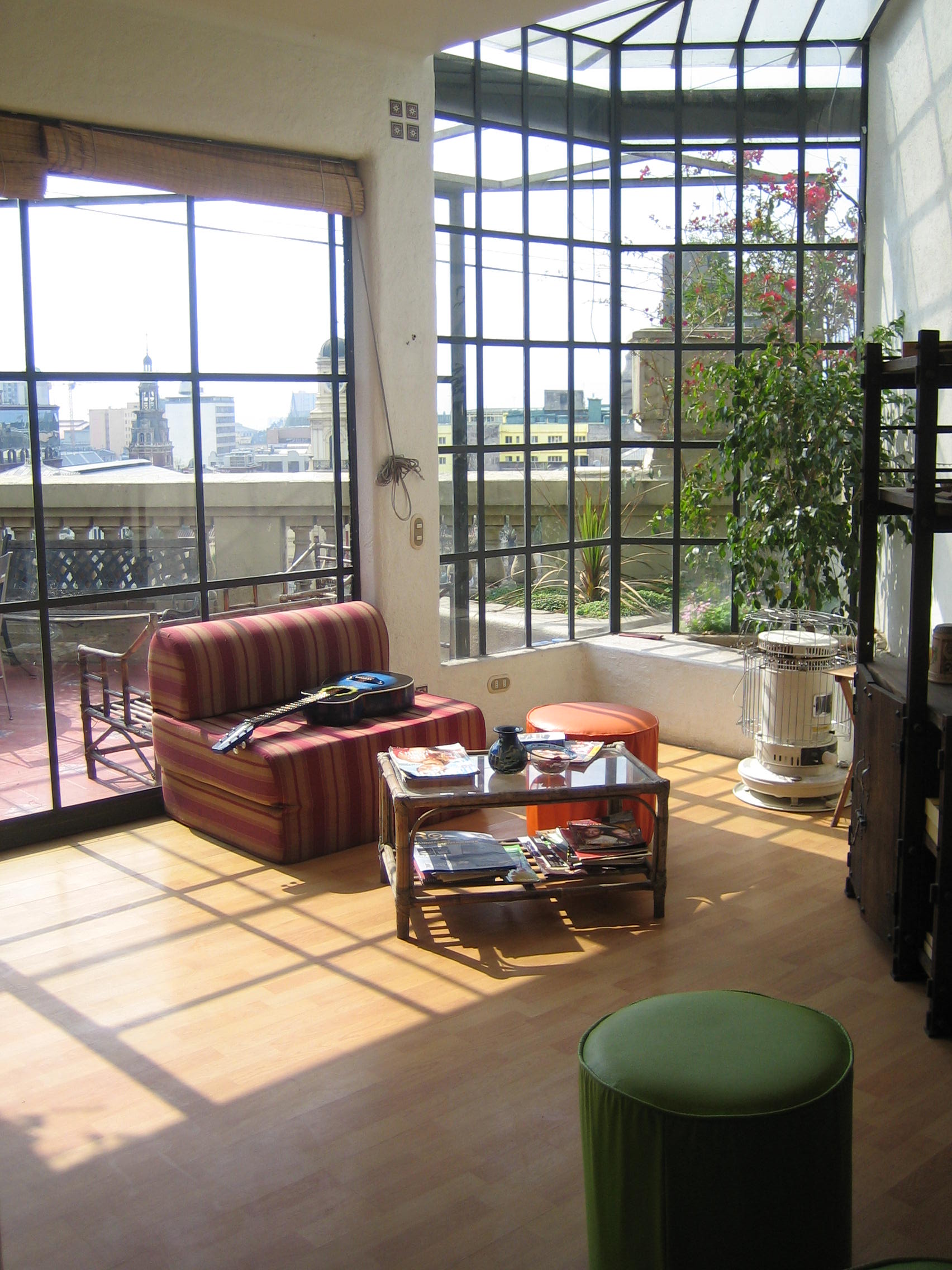
You will not believe where I am and what I am currently doing. I am sitting in what I like to call my dream suite. I am on the sixth floor of what used to be a glamorous hotel, now converted into a less glamorous hostel yet still classic and filled with character. I am in the middle of downtown Santiago, Chile. But it seems like Europe and now I have a real taste of the way Europe has been described to me. The city as I’ve experienced it so far is incessantly busy, filled with pedestrians, lights, and action.

El Departamento de Ensueño
Santiago was a beautiful city and it all started in this suite.
I stand at my balcony, looking down into the grand Plaza de Armas and I see the sidewalk cafés where I can relax and watch the people traffic go by. I see an assembly of goths in their self-designated section of downtown, men playing chess in the gazebo, a crowd gathering around a street entertainer, and everyone else milling about. I still hear the random “chinita”, but also loud music, the deep and hollow bongs of the grandfather clock, and the chileño accent that i have such a difficult time understanding because they drop a lot of their S’s!

Oh, the chilenos… I have never seen so many different kinds of unique faces and of those, so many that have so much character, that spike the curiosity, that can tell a story with a single expression. If i had to base it on the people I’ve been observing – on these first impressions – I wouldn’t be able to describe to you a typical chileno. I can’t even begin to.

But really, I could and would prefer to stay here in my hostel for the rest of the long weekend and beyond. It’s like a honeymoon deluxe, beautifully decorated, lots of glass = lots of light, plants/greens for freshness, high ceilings, antique furniture, classic books on the shelf, a fully-functioning yet quaint kitchen. A lady comes in to lay out a buffet on the dining table every morning for breakfast just for the three of us (Mike, Maria, and I). When we arrived, there was toast, a variety of marmelades, various flavours of tea for every mood imaginable, eggs, fruits, milk.

Then there’s the private balcony that has the most amazing view of downtown Santiago – far enough up on the sixth floor to get the big picture, but close enough to the earth to be able to distinguish inidviduals chatting, kissing, hugging, waving, being. I could stand there on the balcony all day and just daydream. In fact, I could just be here in this hostel all day, curled up by one of the electric heaters and reading a classic. Or dragging an electric heater over to the computer and writing blog entries. Or taking a long, relaxing, and more importantly hot shower (the first time in months), staring up at the sky through the glass opening above.

I am so glad that I decided to travel.

Wisdom

The first phase of the project has finally come to an end. We have officially conducted sixty parent questionnaires in sixty homes to assess the general development of sixty babies. As we take our first peeks at the data we’ve collected and as we clarify and refine the approach for the second stage of the project (much to the surprise, confusion, and sometimes frustration of Maria and I), I have had more than a couple moments of the “What am I doing here?” sentiment.

There is first the “What am I doing here? I’m not right for this job. You have the wrong impression of me. Everyone has been introducing me as a ‘specialist,’ but that doesn’t mean my textbook knowledge is more valuable than your empirical experience. How can I give you advice on parenting? I’m not even a mother yet. I don’t think that I know enough to teach you anything new or to answer all of your questions properly. In fact, maybe I don’t know what I’m doing at all.”

Then there’s the “What am I doing here? I’m now realizing how massive this project is. How can we interpret the data properly? There is so much more that I need to know. Why do the mothers here behave the way they do? How much of this is attributable to culture? How much of the culture do I have yet to understand? How can I possibly contribute to this project if I don’t understand the people I’m studying? I should have locked myself in my room, reading about Peru, when I had the chance to in Nova Scotia. I should have at least travelled to Latin America before. I should have…”

Of the six different areas of development we evaluated, the most staggering outcome of the infant assessments was a clear deficit in infants’ social-emotional development. This area of development refers to their ability to manage or regulate their emotional and social behaviour in a way that society considers appropriate and acceptable. And this is where it gets tricky – what is “appropriate” and “acceptable” in this context and who decides?

Some examples of questions I had a difficult time consolidating:

  1. One of the questions on the social-emotional questionnaire asks something along the lines of: “Can your baby calm him/herself within a certain period of time if you leave his/her side?” We found that a decent chunk of mothers responded no to this question, but we also noticed that many mothers didn’t seem to be worried that their baby could not “regulate his/her emotions” as we would say in child-development-speak. “No, of course my baby can’t be without me,” was a classic answer. At the same time, over 90% of the mothers were amas de casa (housewives) who spend almost 100% of their time with their babies. Is it so surprising that their babies are not accustomed to being alone?
  2. Another question asks if the baby ever puts a banana to his ear, pretending it’s a telephone, or puts some other object on top of his head, pretending it’s a hat. I clearly remember one mother’s answer – in a tone suggesting that she was a little offended – which, to me, explains a common attitude towards pretending/imagination here, “If my baby knows it’s a banana, why would he use it as a telephone?” This strikes my “chicken and egg” curiosity – is this attitude a result of the living situation or does the lack of pretend play (which links to creativity) speak to the way people live here?
  3. During some of the interviews, Maria and I would sometimes notice violence being encouraged. “Go hit the pig to scare it out of the house.” “Throw something at the dog so it’ll stop eating out of the garden.” This had implications for one of the social-emotional questions that asks if the infant or child is ever violent towards other children or animals. But being commanded to be violent towards animals in this way doesn’t necessarily imply an inherent violent nature, neither at this age nor in the future.

The question, then, is whether we can make solid conclusions about the infants’ social-emotional development if it may be considered acceptable and appropriate, at least in some of the towns we visited, for babies to be unable to regulate their emotions without their mothers, for babies to not engage in pretend play, and for babies to show occasional violence towards animals.

Part of me feels a little disillusioned – I knew I couldn’t come here and be a hero, but I’m now recognizing a small part of me that wanted to save the world. There is the temptation to say, “This is how it works where I come from. You’re doing it all wrong. You should do it this way,” and to be harshly honest, I have met my share of development specialists who harbour this attitude. For this reason alone, I’ve found that it’s so important for me to say “I don’t know” and to not be afraid of admitting it. I’m not sure what’s best for you. How can I tell you that the North American theories of parenting are best, let alone that they apply in this context? I can’t make the conclusion that you don’t love your child because you don’t spend a lot of time with him/her – your priorities are drastically different and I respect that needing to survive can be more important than finding time to play with your child.

So, I have come full circle back to the approach I knew I should have had from the beginning – ultimately, this is about sharing. It’s about taking advantage of what little time we do have here to exchange preoccupations, thoughts, and ideas. I learn from you as much as you learn from me. I dispel some of your unawareness of the importance of play, for example, and you teach me the importance of simplicity and working hard. Your knowledge is just as valuable as mine if not more valuable. I am honoured to absorb your wisdom.

Phase 1 Complete

This week, Maria and I are wrapping up phase one of our infant stimulation project in Peru – the individual home visits and infant assessments. We’ve visited five different towns in and around Huancayo, each with a very different feel and personality. Some random thoughts and experiences to summarize it all…

Taller de Paucar
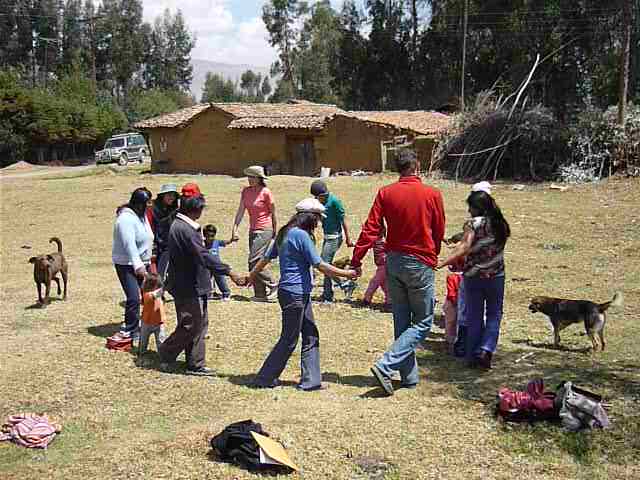
Singing and acting like animals with mothers and children in Paucar.
  1. We gave a workshop in Paucar (one of the more rural towns) teaching moms how important it was to sing songs to and with their babies. I gave my first introductory lesson on the importance of singing to your children (speaking completely in Spanish – okay, it only lasted 2 minutes), then sang song after song, hitting the dry grass like martillos (hammers), pretending to be gusalinos (little worms), and acting out Dinky Dinky spider (no joke, that’s Itsy Bitsy’s name here!) Even with my sore throat, I belted out tune after screechy tune, not fully believing that there I was, leading this group of moms and their babies, singing in Spanish.
  2. It was an adventure in every town, locating the mothers as most of the houses are S/N (sin numero = without number). Sara and I had a particularly interesting morning walking back and forth across chacras (farms) because different people we ran into told us that the other street was Avenida Andre Avelino Caceres. As there usually aren’t any street signs in more rural areas of town, street names are often painted on the sides of houses – and even then, we never found the street we were looking for. So we piled into the colectivo (like a taxi, but they let anyone on), thankful that we weren’t one of the five packed into the trunk, and headed on to the next home.
  3. The moms in Chupaca had a bit more money and almost every family, good hosts as they were, either fed us or at least served us coke. I have never had so much gaseosa (pop) in my life and I don’t even particularly like soda. On top of all this, I already have a bladder problem and try to make sure not to drink too much when we’re going out to the towns all day. Little good that did.
  4. Animals are a general theme of the houses we visited. There always seem to be dogs, hens, pigs, and cows running around, participating in the assessment sessions. Often, one can find guinea pig pens with guinea pigs of all kinds of colours, shapes, and sizes. And can someone tell me if the gallinas (hens) lay eggs wherever they want to since they’re running around all the time? =)
  5. The oldest babies we see are 30 months old (2 years, 6 months), and moms are still breastfeeding at this age.
  6. I was surprised to see some babies with natural stark blonde hair – super adorable. Sara later mentioned that the hair colour could possibly be from malnutrition. Didn’t even think of that.
  7. In Molinos, the furthest town, almost two hours away from Huancayo, we got caught in a mini storm. We could hear the thunder as if it boomed right beside our ears. The rain came suddenly and in spurts, sometimes sprinkling then other times intense with huge droplets almost like hail. Sara and I conducted an interview standing under a tiny awning with the mother, trying not to get our papers soaked. With another family, we huddled with them under a tarp in the middle of their farm, sitting on wood chips, getting bitten by fleas and tiny spiders, watching the father carve Jesus’ face out of sections of tree trunk.
  8. For those of you that are wondering, I am almost always wearing a toque now to hide my silly haircut. =) It works out well for the weather – protects my face from the UV rays, but doubles as a head warmer when it randomly gets cold out. And no, I’m not the only one here who wears a toque under the blazing hot sun!

Grandmommy & Baby

There is a difference between hearing crazy stories about rural Peruvians – choosing your life partner based on a stone throw to their forehead, leaving babies in mud pens to be accidentally eaten by wild dogs – and hearing less-than-crazy but much more real stories from rural Peruvians themselves. Today was day three of infant assessments – we’re spending the next week and a half visiting individual families in their homes in five different locations in and around Huancayo.

Abuelita y Bebé
This baby has suffered so much in her short lifetime, but we're thankful that she has a loving grandmother.
I was surprised to meet a mother hitting almost 50 years in age with an 8-month old baby. As we worked through the questionnaire, her love for her infant was evident. It was hard not to fall in love with the beautiful baby girl, her curious eyes and full head of curls peeking out of the manta (the cloth Peruvians use to carry their babies on their back). She was attentive to her baby, was thoroughly knowledgeable of her baby’s capabilities but also subtle deficits, and was eager to honestly disclose what she knew about her baby so that we could also best share our knowledge on how she could promote the infant’s physical, mental, and socio-emotional health.

As the assessment came to a close, she expressed concern for her baby’s delay in gross motor development – the baby wasn’t able to hold herself up in a sitting position and her legs were too weak to support herself standing even when holding on to a railing or someone else’s hands. From there, her story unfolded. She is actually the grandmother and not the mother of baby, she confessed. She has three children – the youngest daughter was spoiled and wild, accidentally found herself pregnant, then tried to abort the baby on multiple occasions during the pregnancy, taking “special herbs” from the rainforest. The baby was born anyway, but who knows how these abortion attempts may have affected her prenatal development. The grandmother was unhappy with her daughter’s decisions, but didn’t intervene until her daughter accidentally dropped the baby from her manta one day – the baby fell to the ground and rolled a certain distance away, traumatized.

It was the last straw. The grandmother took the baby and the baby’s older sister into her own care, forcing her daughter to work. The daughter now sends money home monthly and when she visits, the baby cries as if her own real mother is a stranger. And such is the life of many of these families it seems.

Horror Hair

I made the mistake of going to the peluquería (the hair salon) today. A good friend and co-worker of mine said she knew just the place. We had to take a combi outside of Huancayo central just to find her. It usually costs 3 soles ($1) to get your hair cut my friend tells me, but this lady charges 5 soles for her work. She had to be good.

We waited a half hour for her to arrive. I took my seat and explained what I wanted in broken Spanish – keep it long in the front, trim the back, fix the bangs, which I had been painstakingly cutting by myself the last three weeks. She starts trimming the back and all seems good. I find it weird that she only sprays my hair with water because I’m used to the soak pre-cut, but I brush it off. What should I be expecting for 5 soles anyway? Then, in one fell swoop, she performs an act so wholly disgusting, rendering me speechless – she cuts almost 3 inches off the front of my hair. My hair was already so short, I was trying to grow it out, and now… I have a mushroom cut and I look like a boy.

For some reason, my friend says nothing as the peluquera cuts more of my hair off, as she shaves the back of my neck with shaving cream and a blade old-school style, as she cuts another inch off my already short bangs. The left side of my hair is now noticeably longer than the right side of my hair, my bangs aren’t straight but I can’t trim it any shorter because they’re already abnormally high on my forehead, and I have stubble on the back of my neck. Above all this, I get charged 10 soles when she usually charges 5 and I don’t understand why. I cannot believe I let this happen to me. This…is…un…fixable.

Yum!

My favourite way to absorb a new culture is through its food and the Peruvians are proud of their food. Sharing a meal is an excuse to spend time to get to know another person, talking about how the food is made is always a conversation starter, and cooking together is the most fun of all!

Last week, Sara and Tabita came over for a work meeting that never did happen (because we’re still waiting for a package of materials from the US that is now two weeks over due and is being held in Lima – long story!), so they spent the afternoon teaching us how to cook papa a la huancaina (Huancayo potatoes). Potatoes are the staple food here in Peru. This Maria and I observed as soon as we arrived here and visited El Museo de La Nación (The Museum of the Nation) in Lima, which was undergoing major renovations and only had two exhibits open – one on the Shining Path and the other on potatoes. It seems common here for Peruvians to eat potatoes with rice as a meal. And speaking of carbs, I remember having lunch at a friend’s house a couple weeks ago and his sister made rice and quinoa for us! That’s like eating rice and rice!

Every morning, Maria and I drink mate de coca (coca tea). One can find coca leaves being sold everywhere in the markets and the Peruvians believe it to be a cure-all plant. For my uneasy stomach last week, for example? Apparently, more coca leaves steeped in hot water longer would make me feel better for sure. During our coca shops, Maria and I have also learned that we can ask for the better quality coca leaves to chew on (not that we do – although, I have to admit that I’ve tried it and it just tastes like leaf).

The dish I was most scared to try was cuy (guinea pig). If the idea already seems unappealing, imagine seeing dozens of live guinea pigs crawling over each other in mesh bags or cages everywhere in the streets. But when you’re in a small village and all the mothers want to show their appreciation for the work you’re doing with their infants by serving you their most prized piece of meat, there’s little you can do. The director of the infant nutrition program of Cáritas (Cesar) tells me it’s super healthy, rich in protein, with very little fat. So I had to try it. I held its little paw in my hand as I tried to scrape the meat off – it’s tough and chewy. They say that the skin is eaten too, but I couldn’t even chew it.

I’ve always considered myself a food junkie. The Food Network is the only channel I watch on TV and I love fine dining even though I don’t have critique-worthy taste buds – almost any kind of food or pastry or dessert or drink tastes lovely to me. But I’ve always known that I’ve been missing a huge part of the world of food – cooking! So I’ve been loving the past month that I’ve spent with Maria who lets me be her assistant. We’ve been making a lot of beans and soups; maybe I’ll perfect these by the end of the trip. As an aside, I was cutting potatoes for our carrot and potato soup yesterday when I accidentally cut a small piece of my thumb off. I put pressure on it for two hours, but it wouldn’t stop bleeding. Eventually, I chose the alcohol route so it would close up. Pain pain pain. My sister says this is why I should have taken cooking classes in high school. Haha!

Search Him

So, I’m going for a walk with my friend, Kevin, through the streets of Huancayo. There are always a lot of people out and about in the evenings in the centre of the city. On a whim, I ask if we can cross over the walkway that spans the busy highway. It’d be fun to see the cars whizzing by from above, I think. We’re walking up the stairs when we run into two young guys chilling in the stairwell. They start talking to Kevin in Spanish and I can’t understand completely what they’re saying. I think at first they’re just saying “Hi” until I notice that they aren’t smiling and that Kevin has given them 1 sol. We’re being robbed.

As far as I understood, Kevin was trying to negotiate. “Search him,” the taller guy said. So far, they’ve left me alone. I’m frozen, watching all of this in amazement and fear. The shorter guy leans in to pat Kevin’s pockets (or maybe to reach inside), but Kevin pushes the guy away. I imagine he’s saying something like, “Calm down. I’ll give you more money.” He takes out his wallet and gives them 2 more soles. They aren’t satisfied. “Search him,” the taller guy insists. I’m thinking of how much money I had in my pockets and in my shoes; if they only knew.

I’m really scared and a million thoughts run through my head. Give them my money. Help Kevin. Escape. Yell. There are so many people walking along the pathway just below us. I feel horrible because this was all my idea. I feel horrible as I start to instinctively inch my way towards the staircase to escape. The taller guy notices me move and puts him arm around me, blocking me. I have never felt so afraid in my life.

The taller guy lets me go for a moment to help his friend out and I run down the stairs, turning back once or twice to see Kevin getting hit in the face, double teamed. A few seconds later, Kevin is beside me. He was hoping for and waiting for me to escape. Apparently he’s a scrapper, has been in many fights before, but was being passive because he was afraid of what they might do to me. On the way home, he spits out blood more than a couple times. I’m saying “sorry” over and over again. He’s just happy that I’m safe. So am I. Peru can be a dangerous place. It was a lesson I needed to learn because I tend to see the world as one big happy place; I tend to be very gullible, trusting. Next time, they might not be amateurs. I’ve gotta be street smart and even then, you just never know.

Update 2/15/11: After traveling through Peru and living in Huancayo for an extended period of time, I’ve learned to become more street smart and I feel incredibly safe living here. In fact, Peru is one of the safest places to live in South America — It’s why I’m back here!

BTU Crew

One of Rik’s projects here is a youth drop-in centre (JPC) for the so-called “thugs” of Huancayo – those who are not necessarily thieves or hooligans, but are nevertheless looked down upon in society because they are different. Most are break dancers, rappers, graffiti artists. All are kind, welcoming, and open.

BTU Crew
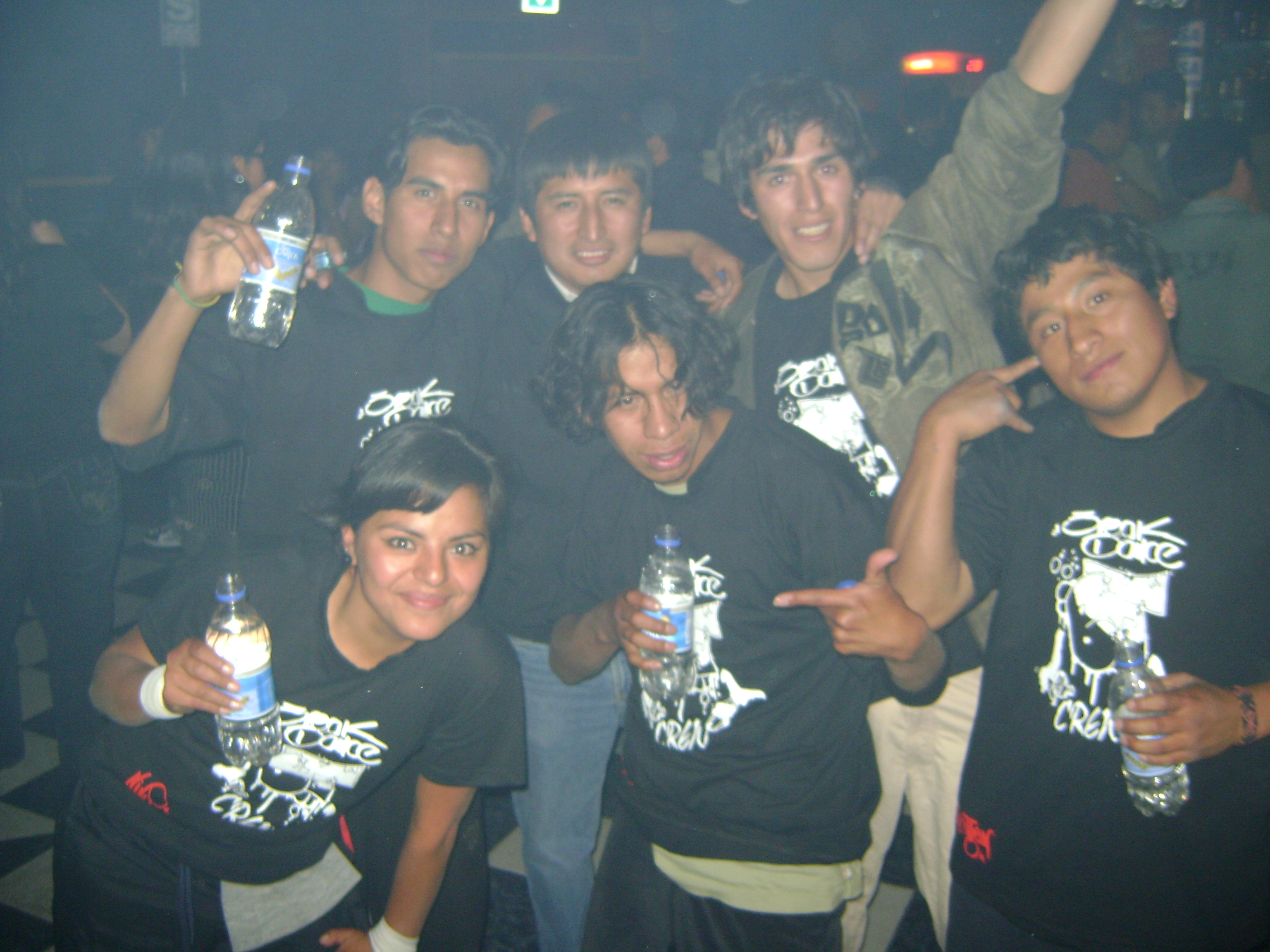
The gang celebrating their success.
Ruth, a young dance teacher from The Netherlands, has been teaching modern dance classes three days a week at JPC and it’s amazing to see the raw talent in these guys shine. They communicate with their bodies, imitating, improvising, expressing themselves – their anger, their strength, their playfulness, their creativity. It’s hard to imagine that these same guys need to work 7 days a week just to pay for food and rent, and could barely afford the 5 soles (less than $2) fee for the field trip to Huaytapallana (one of the most famous peaks in the Central Andes, reaching past 5000m with snow, glaciers, and all that jazz).

The other night, we went to support BTU’s break dancing show at the discoteca. Their show went without a hitch and they were so proud of the shirts they had designed and bought for themselves, the BTU crew, with their individual names stitched on the bottom right of each shirt.

It’s interesting to think how much kindness, personality, and talent many people in Peru are missing simply because they discriminate against these youth. And how much more would these guys thrive if they did have more support from their own community? Despite the odds, they have taken initiative to spend their free time practicing, to seek out opportunities to perform, to write meaningful lyrics, to make music videos with what little they have. Why don’t I have a passion? Why don’t I put more effort into the things that I love when I already have so much love and support from others?

Copyright © 2026 Samantha Bangayan | Sitemap | Disclosure Policy | Comment & Privacy Policy
All articles and photos in this blog are licensed under the Creative Commons Attribution License CC BY-NC-ND 3.0.