Sweet Fifteen

When I look at my schedule and think of all the occasions I attend, I feel a serious lack of special, formal, and large-scale events in Canada other than weddings. (Speaking of which, does that mean people who decide not to marry are just not special enough?) Here in Peru, above and beyond the seven sacraments of the Catholic Church, many young ladies commemorate their coming-of-age when they turn 15 years old at a quinceañera. It’s a major affair almost at par with her wedding day in terms of unreserved attention to the celebrant, recognition from family and friends, and nostalgic moments.

Saturday’s quinceañera was as grand as I imagined them to be. The hall was decorated like a dream – the flowery adornments, entranceway, tables, and chairs were all decked out in the night’s theme colours of cream and purple. We arrive at the location at 10pm. The invitation says to arrive at 9:30pm, but nothing starts until midnight. (Have I ever mentioned that Peruvians are notorious for arriving late? The two-and-a-half hour timeframe is to make sure that everyone arrives on time). So, what do we do for two hours? Eat and drink. Waiters continuously pass by each table with different hors d’oeuvres. As for drinks, each guest has four different sizes of glasses for different types of liquor – pisco sour to start off the night, champagne for the toast, wine for the dinner, and then beer for the dancing. There is no water glass.

During this time, the special lady is spending special moments with her special chosen partner for the night – typically a boyfriend if she has one or at least someone she has a crush on. There’s also a photo session that almost always includes photos on a decorated swing to commemorate her childhood. At midnight, they finally make their way over to the hall.

Traditionally, the star of the show is in a white gown and tiara and at midnight, slowly walks down spiral stairs for all to see. This star is too cool for that. She arrives on the back of a motorbike in a deep purple dress and the night begins. She takes her father’s arm and he walks her down the aisle where 15 of her friends, including the crush, line the way armed with a candle and a rose each. The father leads her to each friend, where she blows out the candle signifying each year of her life that has passed and receives a rose. Afterwards, the father and godfather of the night give teary speeches about how much she has grown and matured, and then the mother gives a toast for her daughter’s future. We reminisce with the family as we watch a slideshow presentation of her life, are treated to a waltz-like choreography by the friends, and enjoy a presentation from the star herself with two masked dancers to accompany her. Then, the rest of the night is all about dancing – a private area is darkened and set up like a club for the young people while the rest of the hall is taken up by the older people, and everyone dances away until dawn.
I spent this past weekend on a getaway trip to the big city – Lima. It takes around eight hours to get there by bus and can cost anywhere between 10 and 50 soles (~$4-20). Buses seem to be able to charge whatever they feel like whenever they feel like it, kind of like gas stations. I understand hiking up the prices during the holidays or special occasions, but we paid 30 soles last week for no apparent reason when we only paid 10 soles when I arrived in September. You arrive at the “landport” (terrapuerto as opposed to aeropuerto) in Huancayo and representatives from all the different bus companies try to sell you tickets to their bus for similar prices. They are mostly double-decker buses with the most expensive seats on the first level that completely recline into beds, and the cheaper seats on the second level.

Real Plaza en Jirón de la Unión
We have a version of Real Plaza in Huancayo too.
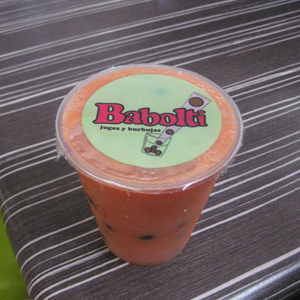
I’ve gotten so used to buildings no higher than five stories, walking everywhere, and regularly recognizing faces that the big city struck me as a little intimidating. There were museums, libraries, open-concept malls (because it rarely rains), massive parks and plazas, embassies, fine dining, familiar fast food, and even babolti (bubbletea)! It felt like a mini vacation, but this time we were set on integrating more than we had during other visits we’ve made – that is, we didn’t use a single taxi to get around town. Instead, we bought a map and spent more time walking and using public transit.

Babolti de Fresa en Lima
Being able to drink strawberry bubble tea again was one of the highlights of my trip to Lima!
The transit system can be really complicated. Thankfully, they just launched the new metropolitano – a rapid bus transit system that runs vertically through the city connecting northern and southern Lima. There’s a dedicated route for these accordion-style buses and you swipe rechargeable cards to board one. Pretty soon, they’re going to launch a new electric train that will run horizontally through the city connecting Lima and Callao (where the airport is). This is a huge relief to me because we’ve had problems getting to the airport the past couple of times – this year, they implemented a new procedure whereby taxi drivers are obligated to have special identification cards in order to enter the airport boundaries. Most taxi drivers didn’t bother with the bureaucracy so the closest they could leave us was just outside the airport, but it can be dangerous around that area especially in the late night hours (when flights to America usually fly out).

Outside the metropolitano path (i.e., getting to the rest of Lima), transit is based almost entirely on combis – minivan/buses that can seat around 20 people but fit at least 50 when everyone’s packed in like sardines. Destinations are painted on the sides of the vehicles and there is always a cobrador (collecter) – his/her job is to yell out destinations and routes, and collect money. Even though they’re often willing to give us more information, considering how we don’t know the streets of Lima very well, we never fully understand which combi to choose or where we’ll end up. Needless to say, we got to know a lot of Lima in a short amount of time hopping on and off combis and finally started seeing patterns and familiar places. A couple more trips and we’ll be Lima experts!

The Threshing Song

Yesterday evening, I visited a small town outside of Huancayo called San Pedro de Saño. As a build-up to the town’s 56th anniversary, they hosted an informal competition of traditional Peruvian dances in their main plaza (that they had just finished constructing this year) of exclusively participants local to the area.

One of my favourite traditional dances is called the “Trilla” – the verb “trillar” means “to thresh” in English. In the dance, there is typically a group of men who go to work in the field, they thresh barley with their V-shaped threshing sticks, the women arrive and give them water for their hard work, and they dance together.

The story of yesterday’s “Trilla” was very different from what I was used to seeing. In the background, a friend of mine sings in Quechua to tell the story. The lyrics told a more serious tale, but there was an air of joy and fun in its presentation and within the crowd.

Below are the parts of the story I was able to extract (because some parts are in Spanish; modern Quechua includes Spanish words and phrases). See if you can pick out when they act/dance each part of the threshing song:

Making a baby
Lift up your child
Give him to his father
Give him to his grandmother
Caring for her grandson
Wash diapers
Smelling, smelling
Kill your child
Stepping, stepping
Now cry for your son
Hit his father
Pull your hair
Bury your son
Crying, crying

Demolished

For months, there has been a lot of excitement over a new restaurant/club that would be opening at the end of September – it’s part of a chain from Lima called Rústica. The construction of the 2-storey building attached to Huancayo’s only mall had been going strong for around three months and faced a main street (Giraldez); people would peek through the cracks around the huge Rústica banners and imagine the yummy food they would have, the live bands they would see, the pizzazz, the action.

During the last week of September, people were handing out Rústica brochures on Giraldez Street inviting everyone to its inauguration on the 30th of September. The blessed day came, I headed over to the restaurant after work in the evening to take part in the festivities, and… there was nothing going on. Everything was as it was before, as if construction hadn’t finished yet, but this time there was a wall of police officers standing at the entrance with their human-tall shields they usually use for strikes and riots.

We heard in the news the next day that Rústica failed to obtain a government license to sell food and liquor on the premises. The inauguration date was postponed until October 7th. We waited patiently.

It’s the morning of October 7th. On the way to work, there’s a commotion at the Rústica site. Police officers are once again in the area, this time actively keeping the public at bay, forcing everyone to cross the street away from the action. Government officials enter Rústica and out comes a single lady, the sole representative available at 9:00am in the morning. They want to demolish the building, but why? Maybe they weren’t able to obtain a license to sell on time? Maybe the government was never planning to grant Rústica this license? We overhear part of the conversation – they needed another license for building on top of the sole wheelchair path to the mall?

The lady yells in desperation: “Esperen! Esperen!” (Wait!) She asks them to wait for her boss to arrive, but the front end loader is already advancing. The truck is already breaking the frame of the front entrance. Other government construction workers throw bricks at sections of glass where the truck isn’t able to enter. There’s more kerfuffle – a guy is pissed that the police officer is shoving him to get out of the way so he drops his bag to start a fight, a lady says that her things are inside the construction (now demolition) site and she wants entry but the officer continues to push her aside like the others.

What a Thursday morning.

I Vote for the Poutine

I arrived in Peru a couple weeks ago in the midst of all the hullaballoo for the elections that are happening today. Every available wall was painted or posted with names of candidates and depictions of the political party’s “symbol” – on the ballot, Peruvians mark an “X” on the symbol of the party (e.g., the shovel, the tree, the pencil, the Incan flag, the gourd, the map of Peru, the Incan cross, the happy face, etc.) “Who are you voting for?” people ask each other (yes, they actually ask each other this) and they respond with the symbols: “I’m voting for the tree for mayor and the happy face for regional president”.

This past week, there have been events every single day for each party’s “campaign closing fiesta” – central streets were closed in the middle of downtown and stages were set up for their rallies with concerts, presentations, giveaways and a lot of flag waving. Then, they get serious – sort of. No liquor is sold starting 48 hours before voting day. It’s a bit of a reunion because people travel all over Peru to vote in their respective towns (depending on whatever address is on their identification card, which usually hasn’t been updated since their last move).

There’s a festive vibe around each school where voting posts have been set up – temporary vendors set up their tarps and sell typical Peruvian meals. In and around the tarps are the queues to get into the school and the voting area. Every so often, someone staring off into space doesn’t move ahead on time and people run to keep their place in line or worse yet, it turns into a scramble. Only one guy’s around to keep order. The elderly, the disabled, and parents with babies can skip the line-up – when there are rules like these, there’s always someone who tries to take advantage. Apparently, someone was able to skip the line by painting fake wounds on his face.

Here, voting is mandatory. There is a fine if you don’t vote – ~CAD$56. Each voter dips their middle finger in dark purple paint that doesn’t come off for days – that way, they let you to exit the voting grounds, police don’t fine you and it also allows you to start buying liquor again. After all, why not have election day be another reason to celebrate?

Celebrate Good Times

Huancayo and its satellite cities in the Mantaro Valley (although only the fifth largest metropolitan area in Peru) are nationally renowned for their festivals and fiestas. There is always something going on and you always know someone who fills you in on what’s going on. Just this past week – my week of arrival – I already found myself busy with different events:

  1. One of the projects of the organization I used to work for held an evening shindig to celebrate their anniversary.
  2. A school hosted a competition for “Youth Day” – students sang, danced, and recited poetry.
  3. A group of us planned a picnic outing to a nearby town famous for its fresh trout (where we met many other like-minded picnickers), and
  4. One of the ladies I used to work with had her baby shower – she’s due in a week!

Let’s not forget the flag-raising ceremony and march of the army band held every Sunday, baptismal and confirmatory celebrations, other anniversaries (of schools, organizations, companies, and towns), and other “days” including “Ceviche Day” and “Pisco Day.”

It’s also worth mentioning Peru’s seven major national events:

  1. They celebrate Carnaval all of February – it’s like the carnaval in Rio where people randomly water bomb you in the streets.
  2. In April, there is Semana Santa (Holy Week) celebrated around Easter.
  3. Arguably the largest celebrations revolve around Fiestas Patrias – Peru’s Independence Day.
  4. October is known as the Mes Morado (Purple Month) in honour of “El Señor de los Milagros” (The Lord of Miracles). Schools and companies get together to create elaborate images on the roads with coloured woodchips to be trampled by purple-clad followers parading through, carrying an image of Christ.
  5. The first day of November is El Día de los Muertos (The Day of the Dead or All Saints Day). In remembrance of ancestors long gone, families set the table with favourite foods of the deceased and/or share the food at the cemetery.
  6. Navidad (Christmas).
  7. Año Nuevo (New Year’s).

It’s going to be a busy year!

In the Heights

I don’t think any other New York experience will top my first time seeing a broadway musical. My friend and I had second row discount tickets that evolved into front row seats when the lady in front of us asked to switch spots because she had a neck problem – I didn’t mind at all, but she was so apologetic that she bought us free pop in souvenir mugs during intermission. What a deal!

Front row seats meant that we could take a peek in the orchestra pit underneath the sewer-like grates at the front of the stage. They meant that we could make eye contact with the actors, notice them wink at one another, and see their hard work expressed in the sweat on their faces. They meant that we could feel their energy and the movement of air when they danced past us. It was intense!

And there was no better musical for me to have chosen at this point in time than “In the Heights.” I had briefly read about it on the internet – I liked that it was about a Latin American (more specifically, Dominican) community in northern Manhattan and that its music style would be a mixture of rap, hip hop, salsa, merengue, and soul, mixing Spanish and English in its lyrics and dialogue.

I already knew that I would like the performance, but I didn’t expect that I would also be able to connect so deeply with the themes and messages.

1. There was the barrio sweetheart who had the opportunity to go Stanford but came back ashamed about losing the scholarship and disappointing her parents who had sacrificed so much for her to go there. They supported and loved her still.

2. The electricity was out and the heat was scorching, but the neighbours were resourceful. Instead of sitting around and complaining, they took advantage of the moment to have a carnaval – they used maracas and wood blocks for music, set the fire hydrants off like sprinklers to cool them down, and danced salsa in its mist.

3. “When there’s an issue or a problem,” the mother reminds both her daughter and husband, “you go back home.” The initial reaction may be to escape or walk out; the grass always seems greener, but when the family core is strong, we are all individually strong. The narrator, in the end, also decides to forego the lottery money he won and the allure of moving back to the Dominican Republic to stay with his community in the Heights.

Ah, oui?

I took rideshare through the company Allo Stop to travel between Montreal and Quebec.

On the way to Quebec, my driver was an eccentric older man and we were riding in his boxy black minivan decorated with purple decals on the sides. I shook his hand and said my name. That was easy. Then he said something to me in French – I shook my head embarrassedly and smiled nervously – “I’m sorry. I don’t speak French.”

“Your bag?” he says.

Oh! I should have known. I thought he might have said “bagages” (bug-AWJ). He asked to take my bag and stuffed it in the trunk.

I introduced myself to the other guy standing around. He was Asian but seemed to only speak French. They continued to chat with each other. Another guy arrived – same deal.

I try to break a quick silence – “So, you speak a bit of English?” I say to the driver. He says he speaks a little. He asks if the others speak English and it seems like they mumble and shake their heads, but later the Asian guy asks where I’m from. It turns out he speaks English really well. He’s from Madagascar and is studying law at Laval – he also speaks Cantonese!

Nevertheless, they preferred to speak French so I spent the 2-hour trip to Quebec falling in and out of sleep in the back seat, noticing at times that someone would turn around to see if my eyes were still closed and I’d overhear a comment about “dormir.”

They were nice enough. I made sure to wave and smile after I was dropped off and they all waved back.

On the way back to Montreal, I had a different experience. This time I was in a luxury SUV with a large, muscular African Canadian man as the driver. I noticed that he didn’t seem very chatty – the girl who sat in the front with him was trying to chat him up for the first 20 minutes but realized that he was only giving one word answers so the rest of the trip was mostly in silence. She was a backpacker through and through with her hair up in an elaborate bandana, handmade bracelets, odds and ends hanging from her backpack, smoking weed at the rest stop. She would turn around randomly during the trip and give me a goofy smile. (I think it was more because I was sitting in the middle in her line of vision and also because I was the only one that smiled back).

I didn’t feel so bad this time because it wasn’t so much like everyone was talking in French and I couldn’t understand; it was more like no one was talking to each other.

At this point, I was proud of what little French words I had picked up and also of my resourcefulness. I had overhead the guy beside me ask the girl behind if the window was alright open as it was (I understood this mostly from his gestures). The girl responded with “c’est bon”. Later, when the driver turned around and said something to me, I was able to pick up the word “bagages” (which I took to refer to the backpack I had in my lap) so I responded with “c’est bon” strategically when a truck was passing by so that my non-French accent would be muffled by the noise. Pat on the back, me!

There was another moment, after the rest stop, that he turned around and asked something similar, this time pointing to the hand rest in between himself and the girl. I assumed he meant that I could put my backpack there if I wanted to. “Ah way?” I say. I had noticed that a lot of people here pronounce “Oui” (French for “Yes”) as “Way” instead of “Wee.”

“Merci!” I say and put my bag up on the handrest so that I have more space.

Aren’t I just so fake Quebecois?

Errands in New York

I have always said that I prefer living in another country rather than travelling through it. So, when I really am just travelling through, how do I get a taste of the “living” experience in such a short amount of time? What can I say if a friend asks: “Well, what do you want to do in New York?”

Please, let me run errands with you!

I spent a beautiful Saturday afternoon running errands with a friend on her lunch break. We walked through her neighbourhood (St. Mark’s – where there are a lot of Japanese restaurants and izakayas) to pick up her compost from her blue-themed apartment and slurped up really yummy frozen yogurt on our way. At Union Square, we stopped to chat with different friends of hers selling at the Green Market that takes up two sides of the large city block. One shared raspberries with us. The other was getting a lot of attention for recently supplying meat to Chelsea Clinton’s wedding. We dropped off the compost with the spiky-haired farmer lady with a thick Austrian accent (I imagine Austrian, but I may be making that up), then found that we still weren’t that hungry so we opted for fresh fruit popsicles (they call them “People’s Popsicles”) to hit the spot.

To top off our “lunch” experience, we dropped by Trader Joe’s (a popular supermarket) where I was amazed to see a line-up around the entire store. I cannot imagine how one shops when there is always a line-up of people in between you and the shelves of groceries. Instead of picking up the frozen strawberries my friend needed, we snatched free samples of sausage casserole to complete our “meal” and called it a lunch.

THE perfect New York experience. =)

You Interpret Me

A couple months ago, I had the chance to meet with a professor in Vancouver who grew up and studied in South America earning her Master’s before moving here. At one point in the conversation, after demonstrating my Spanish ability, I share that I would like to take some courses while in Peru, but that I have a really difficult time with academic articles in Spanish. I feel comfortable conversing with others and defending my opinions, I even recognize most of the vocabulary, but I always finish reading feeling as if I hadn’t understood.

To my surprise, she completely understood and had an unexpected (to me) explanation. How could a born-and-raised South American ever feel the same as I do about reading in Spanish? It turns out, it all has to do with writing style. In North America, there is a clear introduction outlining the body of the paper, then each issue one-by-one, and then a conclusion summing everything up. That’s the way I learned to write and communicate. On the other hand, a respected academic paper in South America can have a lot of back-and-forth arguments with only the mere suggestion of a point – one has to interpret what the author is trying to say. It was why she had a hard time translating an article written by her Peruvian colleague for a North American audience.

To me, it was a concrete example of how a circular or cyclical worldview could permeate a lifestyle and it only made me more excited about what other new ways of being and knowing I will discover.

Copyright © 2026 Samantha Bangayan | Sitemap | Disclosure Policy | Comment & Privacy Policy
All articles and photos in this blog are licensed under the Creative Commons Attribution License CC BY-NC-ND 3.0.