A near century-long dispute has now come to an end. This past weekend, I joined tens of thousands of witnesses who visited Lima’s Government Palace to view the free exhibition of Incan artifacts returned to Peru by Yale University at long last. The story begins with Hiram Bingham, a U.S. explorer co-sponsored by the National Geographic Society who rediscovered and excavated Machu Picchu during various expeditions between 1912 and 1915. Peru and Yale made an agreement that Bingham could borrow over 40,000 archeological pieces consisting of bones, ceramics and jewelry from Machu Picchu for 18 months, but the artifacts were not returned until now.
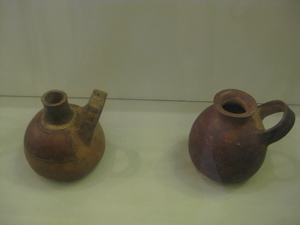
Vasijas Incaicas de Cerámica
These Incan ceramic vessels were part of the collection of artifacts returned to Peru from Yale University.
Historians often refer to Machu Picchu as “The Lost City of the Incas” because it remained hidden from the conquistadors during the Spanish colonization of the Americas. When Bingham stumbled upon Machu Picchu in the 20th century, it was covered in jungle growth and had been unpopulated since the 15th century when Huayna Cápac was still young — Huayna Cápac was the penultimate Incan emperor who is credited with expanding and developing the Incan Empire to its most successful state in history.

So, what do we know of Machu Picchu during the five centuries it remained uninhabited?
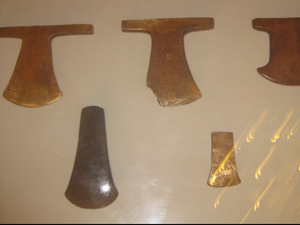
Cuchillos Incaicos
I was able to view these Incan knives at the government palace in Lima.
From one of the manuscripts of the Count of Nieva, a Spanish-appointed governor of Peru, we know that Machu Picchu was part of a major land distribution to Spanish loyalists. It was first entrusted to Hernando Pizarro, brother of Francisco Pizarro who is famous for conquering the Incan Empire, and later to an Arias Maldonado.

In 1992, the historian José Tamayo Herrera found an old deed that states: “Doña Manuela Almirón Villegas sold the lands of Pijchu, Machupijchu and Huaynapijchu to Señores Pedro and Antonio Ochoa for the sum of $350. In turn, in 1782, these men resold the aforementioned lands for $450 to the Spanish mayor of the Urubamba Valley.”

Imagining how many hands Machu Picchu has passed through without the realization and discovery of its value had me thinking — how many things in my own life have I undervalued and later “rediscovered”? Overalls I had thrown in the back of my closet ended up being the predominant piece of my Pippi Longstocking costume. The four years of high school Spanish I left to waste during my university years has contributed to what is now my primary mode of communication in Peru. My entire immediate and extended family, who I had turned away from to follow my own path, were the very people who provided and continue to provide the most support.

What treasures have you “rediscovered” in your life?
Waterless Days

Our toilet usually makes an annoying, sporadic dripping or trickling sound. There have also been a few times, before the rooster on the fourth floor wakes up to crow, that the toilet will make an explosive racket, gurgling and spitting up convulsively. The first time we woke up to the auditory chaos, we thought the washroom had flooded. It turns out, this happens when the enormous water tank on the roof is suddenly switched on after being empty for hours. As it fills, the extremely high water pressure quite literally shoots water down to all the apartments below.

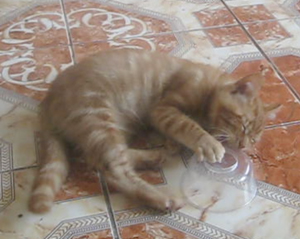
Fénix con su Contenedor de Agua
Poor Fénix crying because he doesn't have water. (He was posing for the camera, by the way).
And then there are days when the toilet makes no sound at all. These are the days we worry because it often means that there’s no water at all.

Today, the toilet was quiet and the landlady knocked on our door at eight in the morning to advise us to collect as much water as we could. I was prepared. These days, I fill any available empty bottles with water. We can at least use this water to flush the toilet. The most valuable water is the pitcher of boiled, potable water we keep in our fridge. This gets rationed out to ourselves and to Fénix the kitty because we’re never sure how long the water famine will last.

Desperate times call for ingenuity and resourcefulness. We were ecstatic when we thought of bringing down rain water that had collected in buckets near the laundry station on the roof. It was a good thing we woke up early because the early bird catches the worm and wins the precious water. This morning, I had the clever idea of trying to empty any existing water that might have collected in our shower tank. Unfortunately, there were only 10 drops.

But we value what we have.

Have you ever experienced not having a key resource when you needed it? How did you approach the situation?

They tell me that they were still using typewriters in Peru in the late 90s. (That was the year I set up my computer with Windows 98). Each student brought their own typewriter to school for typing class. A row of old men with typewriters competing for business in various parks around Lima were in charge of producing the city’s official contracts, letters and documents.

Máquina de Escribir © mconners from MorgueFile
Old school typewriters were the norm in Peru in the 90s.
It helps to explain why I spent an hour in the deacon’s office last week as he painstakingly wrote an official letter for me by hand, giving me permission to study at the local university as an auditing student. I promised to help him access his email and search Google on the days I’m there for classes. He later invited me to the library where I noticed that all the thesis papers before the millenium were also typewritten.

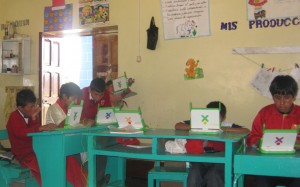
Even today, tech guys in Huancayo get a lot of work doing tipeos (type-ups). Sometimes, people pay just to get their documents typed out faster, but there are still many adults who don’t have any experience with computers at all. In 2007, the Peruvian Ministry of Education joined the “One Laptop per Child” (OLPC) campaign. I was first introduced to the infamous XO laptops when I visited a friend of mine in Miraflores, a rural village outside of Huancayo.

Laptops XO en Miraflores
Children use these XO laptops during computer class.
The idea behind the campaign is that giving laptops to rural children will help equalize their educational opportunity. I thought it was a good idea at the time and I still think that it has many advantages, but the OLPC campaign stimulated a heated discussion among the students at the conference I attended in Chile.

These were some of the arguments:

1. Teachers weren’t being trained. I noticed this in Miraflores. The task for computer class was to copy what the teacher had written on the board and if there were any software problems, the teacher asked some of the more computer-savvy children in the class. I liked how the children developed independent problem-solving skills.

2. Laptops take time away from playing outdoors. It’s a strange sight, seeing a child in the middle of rural farmland with his or her fancy new laptop. Some parents even encourage their children to use their laptops at home to keep them occupied. Though still a relatively new phenomenon, we’re starting to see the development of couch potato habits.

3. Children devalue their hometown. Owning a laptop can make these children feel more equal to children in the big cities, but it also means that many children lose appreciation for their own village or lose respect for their less-educated village elders. Migration out of the Andes has long been an issue in Peru, but we can’t stop children from dreaming big.

What are your thoughts? Do the advantages of the OLPC campaign seem to outweigh the disadvantages? Do you feel strongly about any of these arguments?

I’d also love to hear about your experiences with technology when you were younger. =)

It turns out, the world of blogging is hardly unlike the global community I discovered in Chile. In just these past three months that I’ve started taking blogging more seriously, I’ve forged valuable connections with inspiring people from all over the world. To keep the ball rolling and build on my energy, the universe sent some positive vibes to the Central Andes and I was ridiculously fortunate to win a contest at Chris Richardson’s Travel Blog Support website, where he provides detailed yet easy-to-understand tips and help on optimizing blogs, travel-related or otherwise.

The prize: Migration of my free hosted blog to its very own server!

I’m so excited to announce the launch of my brand-spanking-new professional blog!

To commemorate this occasion and inspired by a couple of my favorite bloggers (Diana Simon and Janine Ripper), I’ve decided to try my hand at posting twice a week starting this coming Tuesday! As I continue working out the kinks until then, have a look around and send some comments my way if you have any recommendations, suggestions or critiques of the new website. =)

— Can’t thank Chris (a.k.a. The Aussie Nomad) enough for literally making this all possible! If you ever need support with a blog transfer, I highly recommend Chris because he made it seamless and had infinite patience with my IT newbieness along the way. =)

“El arte nace del mar de la inconformidad.” – Elio Osejo [Art is born from the sea of nonconformity.]

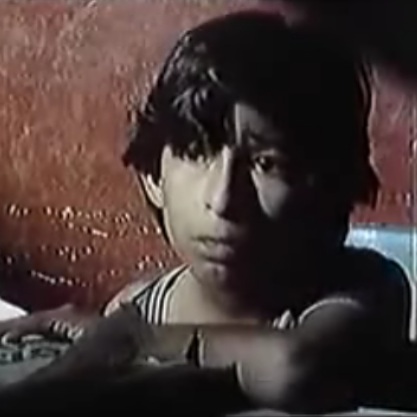
Elio Osejo en "Juliana" (Perú, 1988)
Elio Osejo as a child in a scene from "Juliana" (Peru, 1988).

Elio Osejo is recognized as a famous name from “Juliana,” one of the most well-known Peruvian films of all time, but you wouldn’t know it from the humble and quiet lifestyle he now lives off the beaten path in the middle of the Central Andes. In his role in “Juliana,” the other street kids dubbed him with the nickname “loco” (crazy). It wasn’t because he played a crazy kid, but because he was different from the gang; he was an observer, read the newspaper and spoke wise words for someone so young: “Más y más inflación. Los precios se inflan y los platos se desinflan.” [More and more inflation. The prices inflate and the dishes of food deflate.] True to his character, the Peruvian public called the real life Elio, “loco,” because he never took on another role in his native country despite promises of fame and fortune. He explains that he wants to be constructive and not destructive in his art, but all the lucrative roles they pitched him were of negativity, murder and defeatist stereotypes.

To this day, he remains a nonconformist. As would be expected by society, people try to put him into labeled boxes:

  • For his poetic background
  • For his tendency to initiate and provoke conversation and discussion
  • For his ponytailed long hair
  • For his eccentricity

Some thoughts on the subject from Elio:

Adáptate o Muere Adapt or Die
“Adáptate o muere” me decía mi padre “Adapt or die” my father told me
quien se adaptò un dia a su nueva familia who adapted one day to his new family
y desde entonces no supimos màs de èl and we never heard more of him from then on
“Adáptate o muere” me decía mi madre “Adapt or die” my mother told me
que arrastraba su estigma de leona solitaria who dragged around her stigma of a solitary lioness
y conversaba con sus plantas para no sentir que yo and conversed with her plants to not feel that I
tambien me iba alejando poco a poco de la casa too was slowly drifting away from home
“Adáptate o muere” me decía el sargento sin saber “Adapt or die” the sergeant told me, not knowing
que más tarde descubriría la paz de las mujeres y que that soon I would discover the peace of women and that
mi eterna batalla sería siempre en contra del aburrimiento my eternal battle would always be against boredom
“Adáptate o muere” me decían mis profes “Adapt or die” my professors told me
“Adáptate o muere” me decían mis jefes “Adapt or die” my bosses told me
Miro hacia atrás y escribo satisfecho: I look back and write satisfied:
“La vida nunca dejará de ser maravillosa “Life will never stop being marvelous
hasta para un desadaptado como yo” even for someone who hasn’t adapted like me”
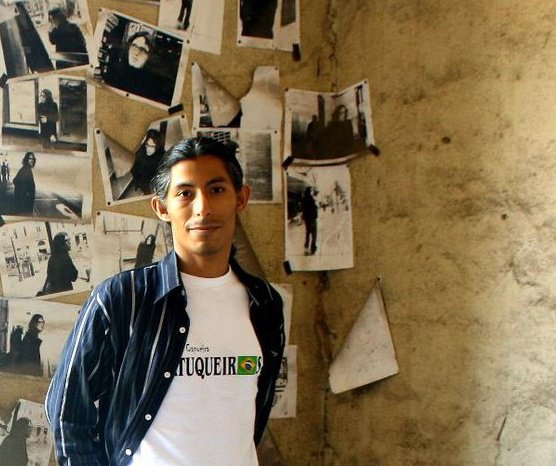
Foto Actual de Elio
Elio these days.

Elio doesn’t fit cleanly into any of the boxes people make for him, if at all, but he does dabble in all communities because he believes that art is about sharing and depends on a deep understanding of life by living it thoroughly. With an attitude of openness, connecting with others provides more than information and inspiration; it provides new artistic possibilities. As Elio reminds me through the wisdom of Zen, we need to continually empty our metaphorical cup and refill it with freshness.

These days, you will find Elio immersed in his latest two passions: poetry and capoeira. Capoeira embodies his philosophy of art and life — it’s not about a fight, but a jogo (game) as the Brazilians say. He teaches his young capoeira students to smile because the goal of capoeira is not about winning. Likewise, writing is not about stardom or money and life is not about achieving happiness. Instead, you live your art as a form of “elevated expression” and live happiness through shared moments, the little things.

What boxes do people try to stuff you into?

A big thanks to Elio Osejo for his time and for the interview.

I had the privilege of spending these past two weeks in San Pedro de Atacama, Chile, assisting at a conference that endeavored to apply research to education. The Latin American School for Education, Cognitive and Neural Sciences brought together not only recognized authorities from around the world, but also an international group of PhD candidates and new professors. They gathered in the small town of San Pedro (population: approximately 5,000) in the middle of the Atacama Desert.

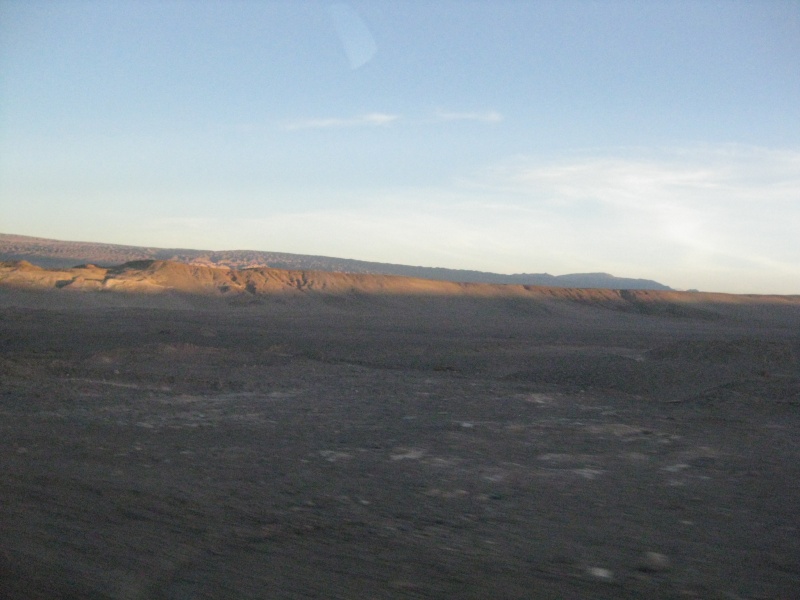
San Pedro de Atacama, Chile
San Pedro de Atacama is surrounded by miles and miles of desert.

There’s something about being in the middle of nowhere that amplifies similarities and fosters connections. We were all affected by dry skin and an unreliable Internet connection, awed by the expansiveness of the desert and the actual number of potentially visible stars in the night sky (San Pedro is one of the best places in the world to stargaze), and afflicted by the earthquake in Japan. For the purposes of the conference, the aura of fellowship encouraged thoughtful discussion about applying the learning and intellectual sharing to the real world. The atmosphere generated ideas, cultivated future research collaborations and motivated each participant to pass on new knowledge to their respective areas.

It was a beautiful example of how the strength of similarities could overcome differences and the beauty lies in getting past stereotypes to experience a true willingness to learn from and through others. There was less identification with divisive labels, such as Costa Rican versus Uruguayan, student versus faculty and scientist versus educator. Instead, the conversation shifted from a comparison about what each person could or couldn’t do to a sense of teamwork with a focus on how people could work together to achieve more than one could on his or her own. We became humbled learners who recognized the essential humanity that bonds us together as part of the same global community.

Achieving openness can be facilitated by a purpose, such as the aim of the LA School, but I believe that this phenomenon can actually happen anywhere. It just requires that you step outside of your comfort zone, outside of the categories that your mind has already formed. The surprises you’ll find can diminish fears, break barriers and, most importantly, construct a sense of connectedness that has the power to lead to positive changes.

Have you been surprised by similarities you share with another? How have you seen or experienced the power of connectedness?

P.S. I made it back home to Huancayo safely and am slowly settling back into the groove of things. Thanks for your patience!

I promised to blog for a cause for International Women’s Day. In the days leading up to today, I thought of all the strong, inspirational women I knew… and felt fearful and weak in comparison as I started my trip down south from Huancayo to San Pedro de Atacama in Chile. It was going to take over 50 hours to get from one place to the other via three buses, which turned out to be four, that arrived late at each destination. I imagined I would use all those extra hours to think about this blog post, but traveling is exhausting, especially when you’re on the verge of fear.

I was afraid about traveling alone as a woman, meeting the wrong people, turning into one of the tragic tales that grace the front cover of daily newspapers and being a victim of the fallibility of developing countries. I’m neither a traveler nor an adventurer; I prefer to settle in and make myself a cozy nook in another country. I chose to purchase tickets from more reputable bus companies, put a lock on my backpack and sleep with my foot slipped through the backpack strap, but there are no guarantees here.

Thankfully, I made it from one end of the Andes to the other smoothly and in one piece even though I can only catch around 50% of what Chileans (and Spaniards and Cubans) say because they speak so quickly. I wondered why I was worried in the first place and am trying to convince myself that the trip back in two weeks will be easier now that I know what to expect. On the way over the Peru-Chile border in a shady-looking mafia car, one of the men I was traveling with told me I was brave for traveling alone. Maybe I really was brave if a person can be brave and afraid at the same time. Today, I want to recognize all brave female travelers and adventurers who aren’t afraid of taking risks, being alone and living without plans.

What comes to mind when you think of Peru?

I now know that people more globally conscious than I am often associate Peru with Machu Picchu, one of the most recognized tourist sites in South America. I’m ashamed to admit that on my first trip over to Peru in 2008, the extent of my imagination was imageless Spanish-like sounds. Needless to say, I didn’t know anything else about Peru and was thoroughly surprised to learn about the wide variety of cultures, traditions, histories, peoples, faces, languages and climates that make up the country.

To express my current perspective of Peru’s overwhelming grandiosity, here is a brief multifaceted look at my adopted country:

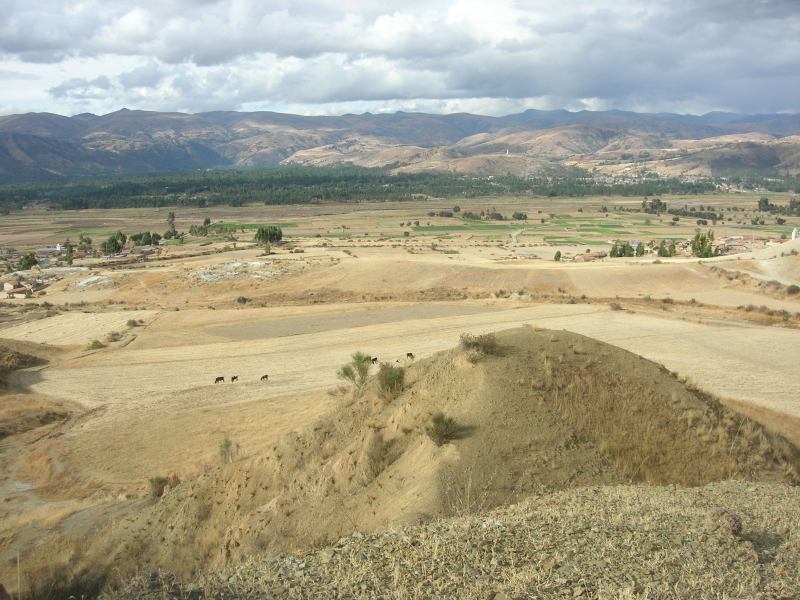
El Valle del Mantaro
This image of the Mantaro Valley is just the tiniest glimpse of Peru.

  • Peru has three geographically-diverse regions. If I were adventurous enough, I could leave the sunny beachside to go mountain climbing in the Andes and finish the day off visiting the mosquito-filled hut of an Amazonian shaman. The diverse climates beget high biodiversity and there are over 5,000 plants and animals unique to the country.
  • Spanish is the official language, but many Native Americans speak various dialects of Quechua, Aymara and around ten other native tongues.
  • Blond-haired Peruvians inhabit Oxapampa, a little town in the central rainforest. They descend from Austrian-Germans who were invited to colonize the area over 100 years ago.
  • Afro-Peruvian music originated from Chincha in Northern Peru, where there is a large population of Peruvians with African roots.
  • The first Asians to land in South America were the Chinese and Japanese who arrived in Peru’s port of Callao in the 1800s and established one of the West’s earliest Chinatowns in Lima. Nowadays, comida chifa (Peruvian-style Chinese food) is a mainstay in Peruvian cuisine.
  • Two traditional Andean dances of Peru made the UNECSO Lists of Intangible Cultural Heritage in 2010: la huaconada — a masked dance of Junín where the dancers symbolically whip all naughty people during the first few days of the year — and la danza de las tijeras — an elaborate dance from the Southern Andes where dancers create a rhythm with pieces of metal used like oversized scissors.
  • Not only are there Incan influences, but Pre-Incan cultures also continue to have a strong presence in today’s Peru, from Chimor’s Chan Chan to the Nazca lines. North of Lima is Caral, the oldest city in the Americas of the oldest known civilization in the Americas, the Norte Chico.

If the mere tip of the Peruvian iceberg can rouse such awe, what more when I consider the entire world and all of its history? The largeness of the world makes me feel small yet connected to humanity, humbled by its infinite knowledge, grounded to generations of wisdom and motivated to continue absorbing the little things.

What does the largeness of the world make you feel?

If you can excuse the Peruvian beer ad, the underlying message of the following video is one of unity. At the beginning, they sing: “From droplet to droplet, the sea is formed. Grain to grain, the sand, the beach. Leaf to leaf, the forest and the entire jungle.” Each person is just one droplet, one grain of sand or one leaf from the standpoint of the universe, but I believe that we are each an important contribution to humankind.

Miaus and Guaus

Huancayo is surrounded by farmland, so I’ve encountered a myriad of animals ranging from livestock for livelihood to city pets in silly clothes. Some animals have a purpose: cows for fresh milk, donkeys for reliable transport and alpaca for soft wool. There are also animals raised solely for food: chickens and pigs. Other animals are clearly pets: dogs, cats, hamsters and iguanas. I’m still getting used to the fact that guinea pigs are always raised for food, often cooked as a special dish, and never kept as companions.

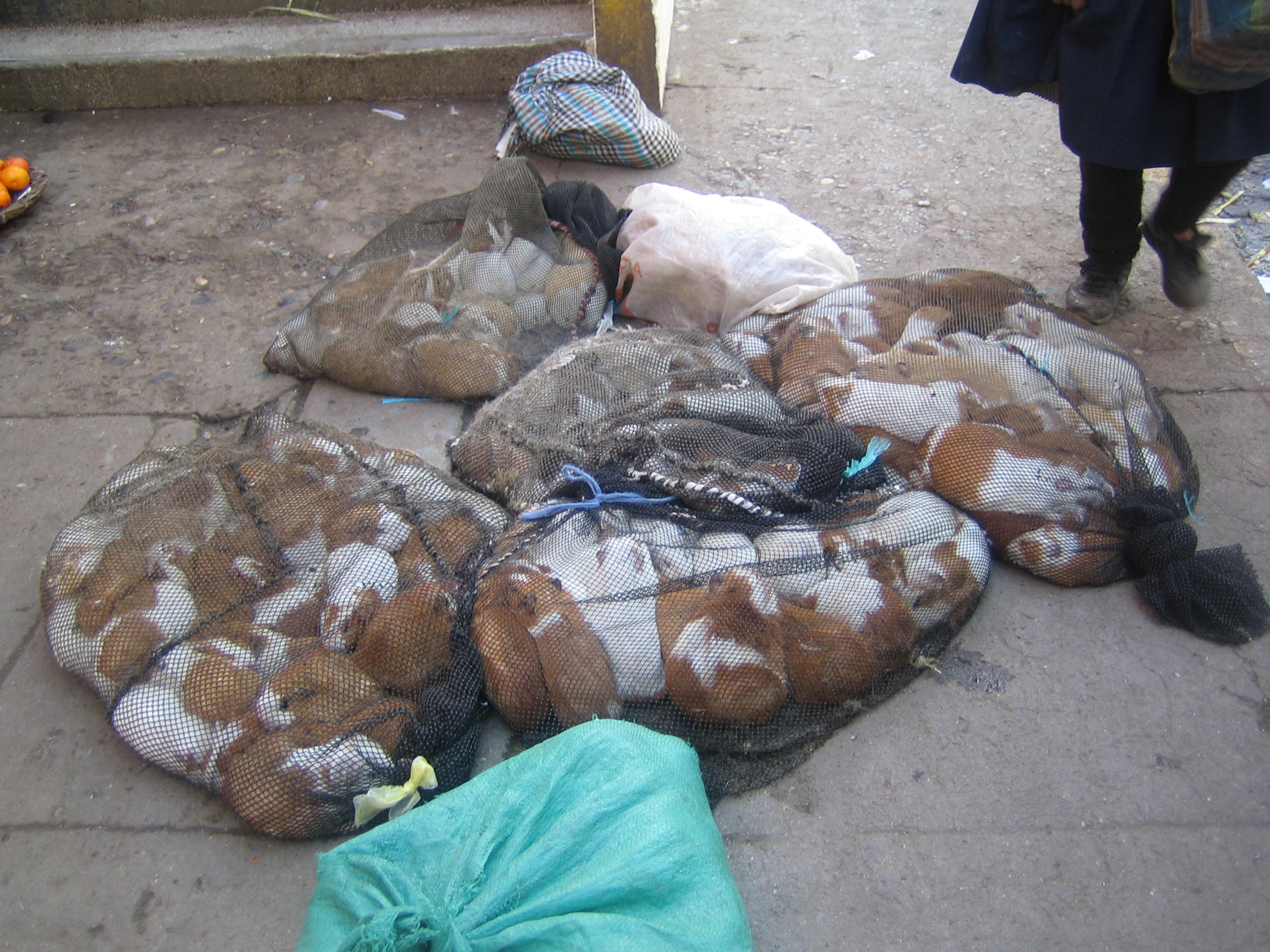
Cuyes en Huancayo
Guinea pigs are served as a typical Peruvian dish.

Since neutering is expensive and uncommon, Huancainos are more likely to receive a puppy from a friend or pick up a stray kitty. Some homeowners have come-as-they-go pets who show up during the day to have a snack, hang out for a while and then leave every evening. Stray dogs are rampant here. They often walk right beside you and sleep in the middle of the sidewalk as if they own the city. You’re part of their daily drama when it comes to scavenging, playing, fighting and copulation. In the more rural areas, stray dogs can be vicious, so you always carry a rock around and hopefully, never have to actually throw it.

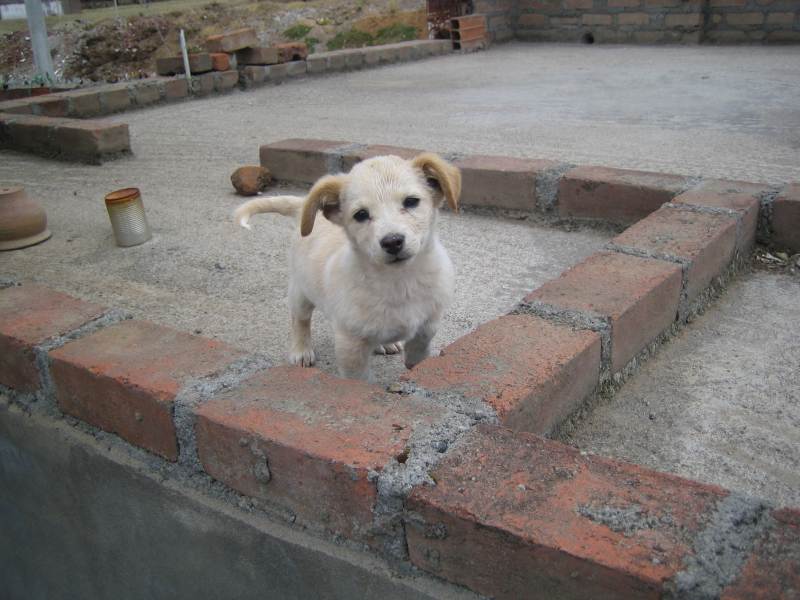
Cachorro en Huancayo
In Huancayo, stray dogs are often taken in as pets.

To communicate with Peruvian animals and animal owners alike, the foreigner must learn new vocabulary of onomatopoeic words. Cats are almost always called “Michi,” often in place of an actual pet name. This name apparently derives from the sound they make: “miau” (“meow”). Dogs are usually pinned “Fido” (“fee-doh”) and they say “guau” (“wow”). I still don’t understand how chicks “pio pio,” although it probably makes more sense that I wake up to the rooster on the fourth floor greeting me with “ki ki ri ki” rather than “cock-a-doodle-doo.” The only other animals that seem to express themselves similarly to their North American counterparts are pigs (“oink”), ducks (“cuac”) and cows (“muu”).

We welcomed a kitty to the family last Thursday and were surprised to learn that he speaks both cat and dog languages, miau-ing and guau-ing in his conversations with us. After a day of fear and loathing for getting him vaccinated, Fénix (Spanish for “Phoenix”) is now purring like a motor, playing with all reachable shoelaces and falling into unescapable buckets:

When 12-year-old Juliana is belted by her step-father 27 times, it’s the last straw; she escapes from the abusive situation and hits the streets. And so begins a tale of courage and resilience in Lima, Peru.

Juliana: La Película (Perú, 1988)
Juliana disguises herself as a boy to work on the hard streets of Lima, Peru.

“Juliana” is one of Peru’s timeless classics, brought to screen by Grupo Chaski. Humbly winning over ten international film awards, “Juliana” tells the story of a spirited young girl who takes life into her own hands. She disguises herself as a boy to join a motley crew of talented kids who make money by entertaining in the streets.

The Afro-Peruvian boys from the coast work together — one plays the cajón (a percussion instrument that looks like a box) while the other dances. The boy from the rainforest uses a tin can as a mini drum and güiro, making rhythm by sliding over the side with a stick. He sings on micros (large combis) while another kid collects money from passengers. Other children have turned into thieves.

The street gang is led by the wily Don Pedro. He gives the boys pointers on how to look poor, takes them to the beach and tells them crazy stories, provides them with shelter and feeds them. Unfortunately, he’s also prone to mood swings and demands that each child bring in a certain amount of money each day. Any child who doesn’t make enough suffers Don Pedro’s wrath behind closed doors.

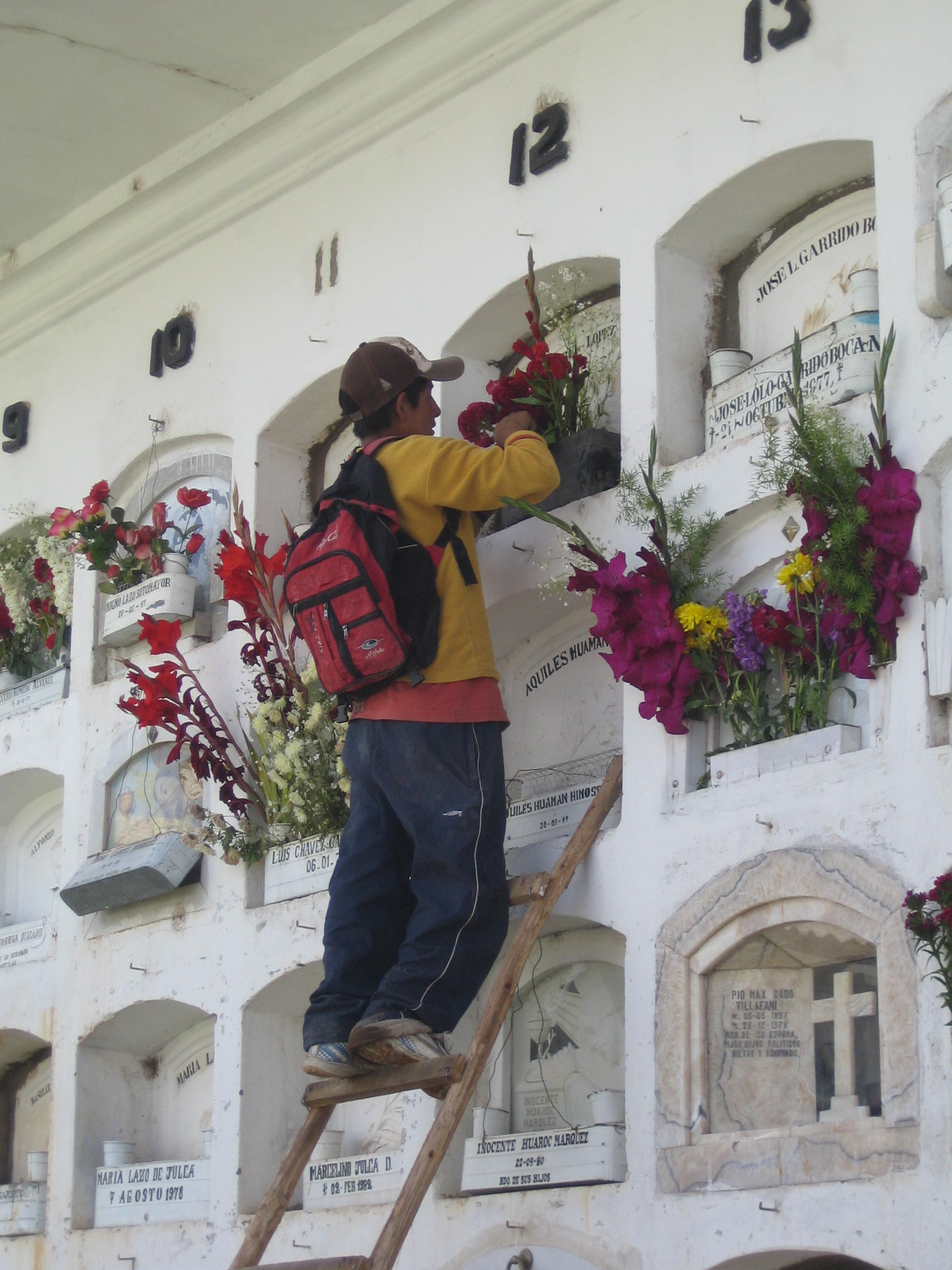
Cementerio Peruano
In a Peruvian cemetery, coffins are inserted into cubicles above the ground and children help you carry up and water your flowers.
The beauty of “Juliana” is that it imparts snapshots of Limeño life in the 80s that ring true even to the present day. I still see the same types of characters and events:

  • The widowed mother puts up with her new partner’s abuse because she’s afraid of loneliness.
  • An evil, beer-bellied step-father represents Peru’s machismo culture. He’s a drunkard who orders his family members around like servants.
  • Juliana works at the ancient Presbítero Maestro, the oldest cemetery in Lima, inaugurated in 1808. She converses with the dead as she cleans their tombs and waters their flowers.
  • Juliana chases down and fights with some kids who rob her.
  • In their free time, all the kids who work in the cemetery play soccer amidst the tombs.

Juliana will inspire you to never lose your spirit, especially when life gets rough. She will show you what it means to be creative because sometimes creativity is exactly what’s needed to make the best of a bad situation, to find your way and to survive. You can watch “Juliana” in Spanish on YouTube.

Copyright © 2026 Samantha Bangayan | Sitemap | Disclosure Policy | Comment & Privacy Policy
All articles and photos in this blog are licensed under the Creative Commons Attribution License CC BY-NC-ND 3.0.