Elio Osejo and Sarah Ellen Roberts had us thinking about labels that others impose on us, but what about the labels we have for ourselves?
I usually visit the local bakery in the morning to buy non-fresh bread (because they don’t make bread until the afternoons – what’s up with that?)
My favorite bakery provides a wide variety of breads.Some mornings, my favorite bakery has no bread at all. Heading over to a local family-owned corner shop, I ask if they have bread.
“Chino o francés?” the plump store lady asks me. Chinese or French?
“Oh, I’m Chinese,” I say.
She was talking about the type of bread I wanted.
Besides feeling ashamed that I was so full of myself, the incident had me thinking about our instant reactions to labels and how we identify ourselves.
What are some labels you may unconsciously and automatically identify with? Are you hearing only what you want to hear? Are these labels hindering your growth or empowering you?
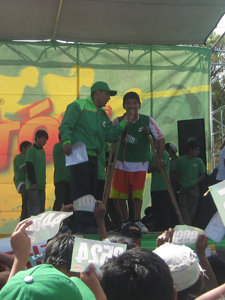
Yesterday, Nestle Milo hosted their annual five-kilometer race through the city — the Milothon. Out of the near 10,000 youth that participated in the event, the winner, in my eyes, was a 17-year-old in crutches who finished the race strong.
Christian shared his message with all the youth at the 5K race that they too can overcome any obstacle.I had the chance to meet Christian because he wanted to take a picture with one of the dance groups that performed for the event, but he didn’t have a camera. Needless to say, I was happy to take some pictures for him and send them to his email address.
What instantly captivated me about Christian was his cheerfulness and warmth, even as he told me about the naysayers along the route. He kept on keeping on despite those who pitied and ridiculed him along the path. They told him that this race wasn’t for people like him. Little did they know that the Milothon hasn’t been his only event. He also finished the Andes Marathon — yes, the full 26.2 miles — even though it took him double the time that it takes a typical runner.
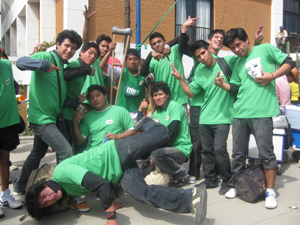
Christian wanted to take a picture with Ignition Crew, a Huancayo dance group, and I happily obliged.Physical disability is common and open here in Huancayo because most people with disabilities resort to begging in the streets. I have a feeling that Christian’s not going to be one of them. It was his social worker who told me that his parents can’t afford the physical therapy sessions he needs; his father drives a taxi and his mother washes others’ laundry. The social worker also mentioned that he has had this problem with his legs since birth; I didn’t ask, but I suspect it’s polio.
Nevertheless, you don’t see Christian asking for pity. He says that he wants to study medicine and I think Huancayo needs more doctors who have his strength, compassion and humility.
Feel Christian’s warmth yourself in this short message he wanted to share with all of you:
How have you shown enthusiasm and perseverance against a recent obstacle in your life?
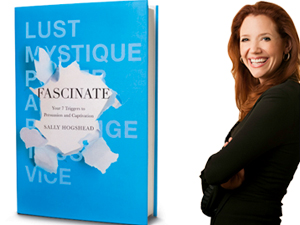
Wouldn’t you prefer to fascinate rather than just affect, influence or impress? Read on to learn more about what it means to fascinate and how you can fascinate those around you.
Sally Hogshead identifies seven triggers we use to persuade others.As a person who values self-knowledge, I was excited to learn about Sally Hogshead and her theory of fascination through my good friend Gonzalo Suárez. The idea is that we use seven different fascination triggers to persuade those around us. Out of those seven, we have a primary trigger that we should harness to share our message and purpose more effectively.
These are the seven triggers she describes:
Prestige – increases respect
Power – takes command
Mystique – arouses curiosity
Passion – attracts with emotion
Alarm – drives urgency
Rebellion – triggers creativity
Trust – builds loyalty
I took Sally’s 28-question F Score Test and was surprised by the result: my primary trigger is rebellion. I’m hesitant about the word’s connotation, but I’ve come to embrace its meaning. I take it to mean that I’m curious, independent and break away from the norm. I wouldn’t have made it here to Peru without my so-called rebellious streak and I’m realizing how important it is to me that I continue encouraging others to follow their passion and intuition with the same vigor.
Which fascination quality is most important to you and how are you using it to your advantage in your life, personal brand or business?
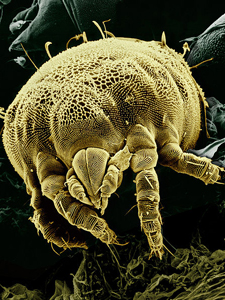
Mites are microscopic creepy crawlies that tunnel underneath the skin. Sometimes, you can see a thin, gray line on the surface of the skin where female mites have burrowed. The most uncomfortable symptom is the itchy mosquito-bite-like bumps you get all over your body. I should know because I’ve caught scabies — an infestation of mites — over five different times here in Peru.
Mites are near impossible to see. These little bugs can leave you itchy for weeks if the scabies is left untreated.You can get scabies from prolonged, direct skin contact, but mites can live off of their host for up to three days. People who have a weak immune system can get crusted scabies, which is especially contagious. Although they say it’s uncommon, I suspect that I’ve picked up mites during the classic Peruvian greeting of a kiss on the cheek, from sitting on a chair of someone infected or through giving a warm hug. Doctors tell me that the infection is more likely to happen in crowded places and in the rural communities around Huancayo where people have weaker immune systems from malnutrition.
I have become an expert when it comes to scabies treatment. To begin with, I put on permethrin lotion, which is an insecticide. As the permethrin is working its effects, we set the apartment up for fumigation and pull the tab on the can of Raid that will thoroughly clean out our small home. We then take Fénix the kitty out for the afternoon, until the apartment has finished fumigating.
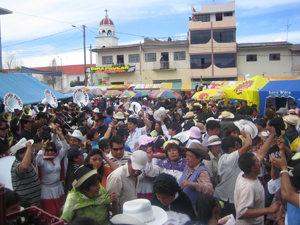
Crowded celebrations are typical in the Mantaro Valley. I may pick up mites during these kinds of events.I’m no hypochondriac, but it’s annoying to get itchy bumps all over my body; when I have scabies, I’ve had over 20 bumps appear in one night. I probably shouldn’t be using such a strong insecticide on my body so often because permethrin is known to be a carcinogen in high doses, but the weaker cream I tried didn’t work. It’s also a hassle to fumigate the apartment and I’m down to the last Raid can I brought here from Canada.
I’m no Mother Theresa, but I consider myself a warm and caring person. I learned early that touch is one of most powerful ways humans can communicate with each other and that a single hug, handshake, hand on the shoulder and linking of the fingers can often mean so much more than what can be expressed by words. I believe that the world lacks the warmth of touch between people and one of the reasons I love the lifestyle here in Peru is because people are less afraid to show affection through touch.
Some friends and family have advised me to stop hugging people.
Have you ever hugged someone that others wouldn’t expect you to? Maybe a homeless person? What do you value more — health or warmth?
As the legend goes, Sarah Ellen Roberts was one of Dracula’s brides. Due to allegations of murder and witchcraft in her hometown of Blackburn, England in 1913, Sarah Ellen was sentenced to execution and as a punishment, she was to be sealed in her coffin alive. The Church of England refused to have her buried on sacred ground, so her husband, John Roberts, was forced to travel around the world to find a place that would accept her remains. He finally succeeded in laying her to rest in Pisco, a little port town in Peru.
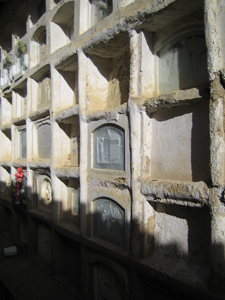
The legend says that Sarah Ellen Roberts' graves was one of the only ones left intact after the 2007 earthquake in Pisco.It’s said that as the coffin closed, Sarah Ellen swore that she would be back in 80 years to take revenge. The inhabitants of Pisco awaited the day of her death anniversary in 1993 with fear and apprehension. Stores began selling “anti-vampire kits” that included a crucifix, a wooden stake and garlic. Mystics began throwing holy water, singing hymns, praying and chanting near Sarah’s grave. Hundreds of curious spectators made the trip to Pisco to witness the anticipated resurrection.
When Sarah Ellen didn’t appear, the mystics rejoiced and took credit for the so-called phenomenon. Others weren’t so sure and there were various sightings of a strange lady walking the streets of Pisco in the evenings. The story took a turn when Pisco suffered an earthquake in 2007 — Sarah Ellen’s grave housed one of the only tombs that remained unopened. Citizens of Pisco began saying that she was in fact blessed and must somehow be a holy saint to have “survived” the earthquake.
The citizens of Pisco believed that Sarah Ellen the vampire had turned into a saint.Surprised by the Peruvian media sensation in 1993, British historians dug deeper to find that Sarah Ellen was just a typical mother. The census at the time shows that both Sarah Ellen and John Roberts were weavers. During a visit to Peru where John’s brother had opened a cotton mill, Sarah Ellen passed away unexpectedly. The Roberts grandchildren suspect that she passed away in some isolated area and that her husband may have carried her coffin into the town of Pisco, sprouting a wealth of rumors.
Nevertheless, what a legacy she left!
People have also made a legend of my life. Sometimes, I experience privilege here in Peru when others learn that I’m Canadian. It can be a special advantage because people may take my words more seriously and I have the opportunity to make positive changes, but it can be a disadvantage when others hold the false beliefs that I must know the answer to everything and that I must be rich.
When have others taken over your legend and has it been for better or for worse?
In the early 1980s, international archeologists funded by the U.S. National Science Foundation excavated various sites in the Mantaro Valley where I now live to piece together the Central Andean past.
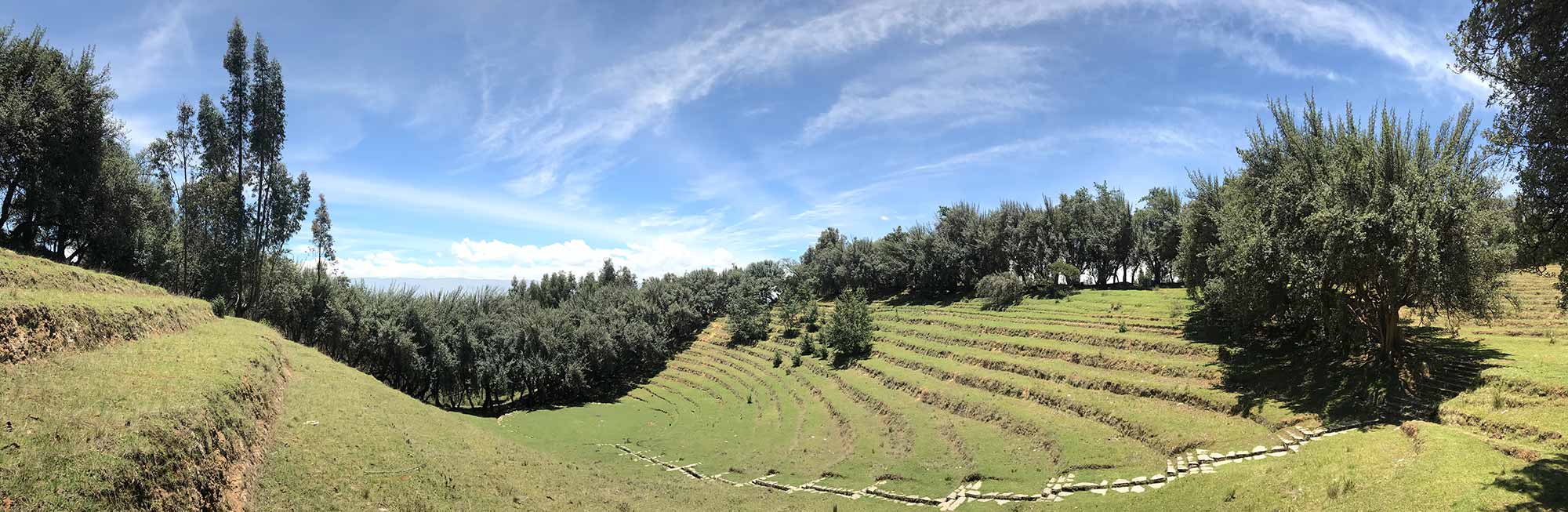
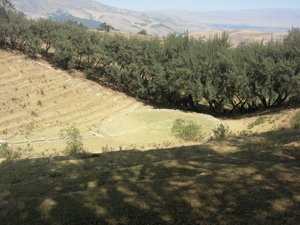
We found this hidden amphitheater during one of our treks through the mountains of the Mantaro Valley.The Huanca society dominated the valley before the Incas arrived in the 1400s, organizing the zone into a province of their grand empire.
What was the Huanca culture like?
Along with ethnographic research, the bits and pieces unearthed from known Huanca communities in the area tell us the stories of Huanca families.
Finding pieces of deep serving basins in a household zone marked an elite family. They used the basins for hosting Andean ceremonial feasts.
Elite patios had more deer, maize and coca remains. They were able to eat more maize even though it wasn’t a very productive crop at the time and chew on coca even though it wasn’t produced locally.
Bits of hoes, sickle blades and digging sticks were distributed throughout each household zone, signifying the importance of agriculture as a source of economy. Fewer farming tools were found in elite households. They may have received payments instead.
Spindles found in each household suggest that families made their own clothes.
Manufacturing remains found in certain Huanca communities suggest that these communities specialized in the production of certain goods, such as ceramics, and exchanged the commodity with the locals.
When the Incas pacified the area, the economy and lifestyle remained relatively unchanged although commoners ate better and survived longer based on food remains and burial data.
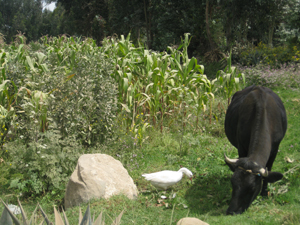
Agriculture continues to be a strong source of economy in the Mantaro Valley.In analyzing the set-up and items in my own household, I imagine that historians will be able to tell that there were two people living in the apartment (two placemats on the dining table), we had a kitten (little bowls and cat toys on the floor), we were extremely organized (everything in its place), we valued learning (books and newspapers strewn about), and we were savvy with technology (various computers, machines and cables).
What would historians say about you based on your household?
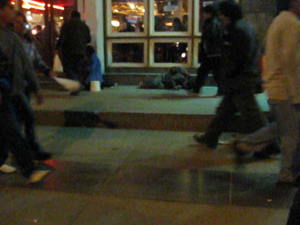
No one knew that he was dead. He sat upright against the wall for support, his head hanging forward in a resting position. He had been robbed of everything after exiting a nightclub in Huancayo and they left him there, probably imagining that he’d wake up from his drunken stupor. He didn’t. Instead, he died of hypothermia from a cold Andes night.
People have become numb to drunken men sleeping on the streets of downtown Huancayo.No one helped because it looked like he was just sleeping and it’s not uncommon to find a sleeping, drunk man on a street of Huancayo. We have become desensitized to the sight.
The “bystander effect” states that we are less likely to help someone in trouble if we’re part of a larger crowd. “I’m sure that the other guy will help,” we tend to think. Then, no one does. There are victims.
What have you become desensitized to? Please inspire us by sharing about someone you recently helped who may have been ignored by society.
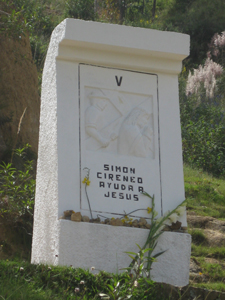
According to Catholic tradition, the devotion of the “Via Crucis” or “The Way of the Cross” honors the last few hours of Jesus’ death. It consists of a spiritual pilgrimage, acknowledging 14 stations or shrines that depict distinct events beginning from Jesus’ death sentence to his crucifixion and burial. The phrase “via crucis” or “way of the cross” is also used to symbolize all the obstacles we need to overcome when we try to achieve a certain goal.
The fifth Via Crucis station commemorates when Simon of Cyrene helped Jesus carry the cross.Along with thousands of other Peruvians across the country on Good Friday, we did Huancayo’s version of the Via Crucis. In Huancayo, the 14 stations are set up on a winding path around a hill with a giant metal cross adorning its peak.
Other than the typical route where you pray and leave a rock at each shrine along the way, there are two other ways up the hill. You can ride a taxi up the winding path, speeding by each of the shrines, or hike directly up the hill, bypassing all of the stations. The latter is the fastest route up, but it’s also the more torturous path because of the steep incline of the hike. As an afterthought, it could be an experiential way to signify Jesus’ suffering during the Passion.
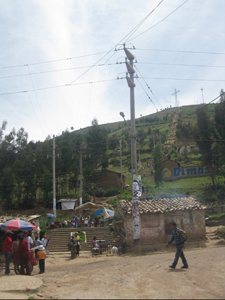
Most people took the direct shortcut up the Via Crucis hill.Joining the majority, we tightened our shoelaces to huff and puff our way up the hill via the direct shortcut.
In undertaking this mini pilgrimage today, I realized that living in Peru has become somewhat of a pilgrimage for me in the sense that I was drawn to a place that was meaningful to me and the journey has been transformational, endowing me with insights and understanding. Although I haven’t taken the typical route and I sometimes feel like I’ve chosen the tougher passage, I have also discovered more and more people along this path who have motivated me and helped remind me of the value of my choices. In the blogging world, I would especially like to thank Janet Callaway, Sherry Zander, Rowena Bolo, Karen Swaffield and Diana Simon.
They say that when you return home from a pilgrimage, nothing is ever the same again.
Aside from collecting rent and ignoring all that needs to be fixed in the building, our landlady believes that her role also entails encouraging and producing gossip. This task occupies her time while her husband is away for most of the year, working a mystery job in Northern Peru. This may explain why the gentleman who lives in front of our building is one of our landlady’s favorite targets. Apparently, the man is in love with her but shows his affection in odd ways as they maintain a distant love-hate relationship. He enjoys throwing water on the patio when her son is playing and leaving his sweepings in front of her door. She enjoys knocking on his door to complain.
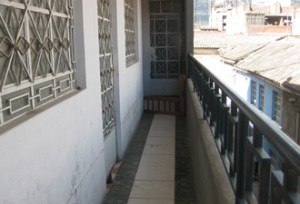
The landlady set up a little fence at the end of our hallway to keep the dogs out. They just jump over it.When she knocks on our door to chat, we know she wants to gossip about the girl who lives in the apartment beside ours. We call her the “charapa” (a standard nickname for Peruvians from the rainforest) and the landlady likes to get updated on what she’s been up to. The charapa’s apartment and ours was originally constructed as one unit and the thin wall that now separates us never ceases to present opportunities for unintentional eavesdropping. She’s the wild child of the apartment family, disappearing for a couple months without paying rent or letting the landlady know, introducing her boyfriend as her brother, having random men leave her apartment in the wee hours of the morning and going clubbing on Sundays.
The landlady's three dogs overrun the roof.The one door the landlady ignores is of the stout lady (henceforth, Mrs. Stout) who lives on the second floor. It’s only been three months, but they’ve already developed an intense rivalry and the landlady can’t wait to get rid of her. The reasons accumulate:
Strike 1: Mrs. Stout hosts a lot of loud, drunken parties with guests always overflowing into the hallways.
Strike 2: Mrs. Stout throws garbage down her sink, which empties out right by the landlady’s door.
Strike 3: Mrs. Stout’s dog lives outside of her apartment and he often does his business in front of others’ doors on all three floors.
It’s silly to see how the two ladies greet everyone but each other, how Mrs. Stout will shake out her doormat on the public stairs and how the landlady will let her own three dogs out to cause havoc with Mrs. Stout’s little mutt.
I wonder what the landlady says about me.
I’d love to hear about a character who lives in your apartment or neighborhood! =)
“El tiempo me ha enseñado que la felicidad sólo es verdadera cuando haces lo que quieres con la gente que quieres.” – Vania Masías Málaga [Time has taught me that happiness is only real when you do what you want with the people you love.]
Ventanilla is one of the poorest districts in Lima.Vania Masías was named prima ballerina by the Municipal Ballet in Lima. From the ripe young age of 8, she built her dance career to worldwide superstardom, dancing in Cuba, Spain, Italy and Germany among many other countries. Her first principal role was in the Nutcracker and by age 23, she was hired as Senior Soloist with the Irish National Ballet. At the height of her career, she beat out 300 other international dancers after a gruelling three-day audition in London to reach one of two final spots in Cirque du Soleil’s production, “Love” in Las Vegas.
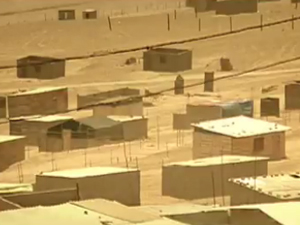
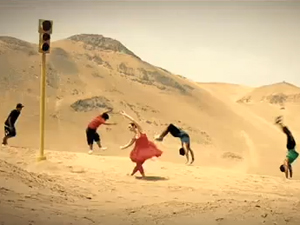
Ventanilla is the other face of Peru’s capital city — a district on a sandy hill, haphazardly established long ago by poor, squatting families who couldn’t afford living in the city center. The instability of the houses constructed on sand mirrors the unpredictability of lives in poverty. At least one advantage of living on a sandy hill is that the environment is favorable for practicing flips and acrobatic tricks. As such, a group of boys from the neighborhood banded together to form “The Sand Angels.”
Vania’s chance meeting with these angels changed the direction of her life.
Vania Masías left behind international opportunities to start a dance company with boys from Ventanilla.On her way through the daily grind and the busy streets of Lima, Vania waited at a typical stoplight where she witnessed street kids flipping and leaping through the air. They were doing acrobatics to beg for change. It was this two-minute display of talent that inspired Vania to take action. She left behind her success and reputation in the international dance world and held auditions in Ventanilla to start the D1 dance company with many of “The Sand Angels” as part of her first group of students.
Her professional dance studio in a more wealthy part of town funds free classes for impoverished yet talented dancers. Now, one of her graduates is a professional dancer in Finland, several others are hired by her dance studio and still others have found employment across Peru through their experience with her dance company.
What is your true passion and how have you followed it to places you never imagined?