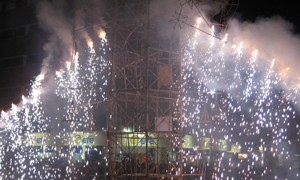
Castillón in Huancayo

In Peru, big community fiestas celebrating patron saints usually involve castillones, tall pyrotechnic towers. Fireworks and sparks shoot out from these castillos (castles) in a series of spectacular shows as Peruvians often celebrate right underneath the extravaganza. I still have a tiny scar from a projectile firework that landed on my upper back as I danced under the castillon during my very first few days in Peru, celebrating the patron saint, Santiago, for Peru’s Fiestas Patrias (Independence Day).

The toro loco (crazy bull) is a variation of the pyrotechnic tradition. A person holds up or carries a bull-shaped structure on his head and runs around through the crowd as sparks and sometimes more propeller fireworks fly out from the “bull.”

There’s a reason the use of fireworks by the public is banned in various places around the world, including Davao City (where I was born in the Philippines), Ireland, Chile and Malaysia.

Get a feel for the grandness of these types of celebrations with castillones and toros locos in the following video.
What kinds of positive or negative memories do you have with fireworks? Are celebration and tradition worth the danger of fireworks?

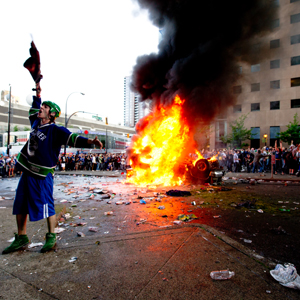
I was raised in Vancouver, Canada…where the riots happened on June 15th, 2011 after the Vancouver Canucks lost the Stanley Cup final. I want to follow up with: “…but my city isn’t really like that.” And it isn’t.

So what happened?

They’re calling it the “Vancouver effect”: out of 200 sports riots, we’re the only city that riots after losing a game rather than winning it.

The result was this:

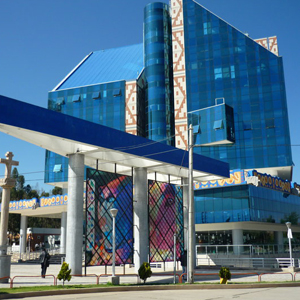
Over this past month, we’ve seen similar violent disturbances erupt in Huancayo between students from the local university and the police. The students from the Universidad Nacional del Centro del Perú (UNCP; The National University of Central Peru) organized marches and locked down the university to expose the corruption within different faculties and particularly of the Head Dean, Carlos Adauto Justo.

La Universidad Nacional del Centro del Perú (UNCP)
The UNCP is the site of the violence in Huancayo this past month. © Maita Perez, Wikimedia Commons
Just like in Vancouver, there were police officers with shields and masks, and over one hundred citizens were wounded from physical aggression or from tear gas while a similar number of people were arrested.

Unlike in Vancouver, the students in Huancayo didn’t loot any stores or take celebratory pictures in front of the destruction.

The major difference between the two scenarios is in the purpose behind the violence. The students have made the purpose of their strike clear. Violence is a byproduct, a reaction to police aggression upon the Dean’s command to “bring order” (link in Spanish).

Los Disturbios de Vancouver 2011
What was the purpose behind the violence of the Vancouver riot? © Wikimedia Commons
On the other hand, pundits are having a hard time explaining the violence behind the “Vancouver effect.” Did Vancouverites so strongly identify with their hockey team that the loss felt like a personal attack on their self-worth and identity? Were the aggressors just hooligans looking to start trouble? Were they even from Vancouver? Did people follow along because of a herd mentality?

In your opinion, what’s worth physically fighting for or becoming violent for? What would justify violence for you?

When I spent the last week in extreme pain from stomach cramps and a potential infection, people back home asked me: “When is it enough? Huancayo isn’t cut out for you.” There was the implication that I should move back to Canada.

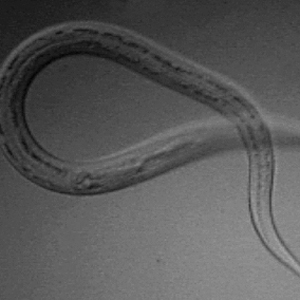
Parásitos Gusanos
They think that my severe stomach cramps last week are from parasites. I'm still waiting for the results.
Here’s the medical history of my time in Huancayo since 2008:

  • A biopsy to diagnose a chronic rash on my forehead caused by the burning heat of the sun at this altitude.
  • Over five cases of allergic reactions to mites and the hassle of fumigating the apartment each time.
  • Recurring bacterial infections, strep throat and a yellow tongue.
  • Allergic reaction to antibiotics.
  • The myriad of negative side effects from different medications.
  • Tummy troubles from the change in food quality.
  • Parasites.

It’s difficult for my body to adjust to a new environment. In fact, there’s no promise that my body will ever adjust. Doctors take a trial-and-error approach to treating me because they don’t know what medications may be too strong for my body.

My good blogging friend and favorite shrink, Hajra Khatoon, helped me brainstorm through the predicament with the following questions:

  • Will you move because of your health – is it that bad that you need to move?
  • Do you enjoy living there?
  • Do you enjoy the career you are pursuing right now?
  • Are you happier here or will be happier back home or anywhere else?
  • Are you enjoying the experience the stay is offering you — personally, professionally, emotionally?

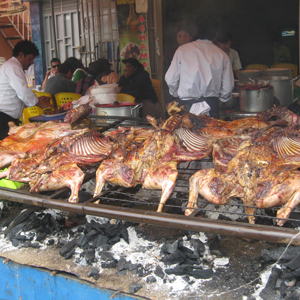
Comida de la Calle en Huancayo
I'm more likely to get sick from street food in Peru.
It’s easier to be happy when you’re feeling healthy, but happiness can also predict health. At the very least, the simpler and relaxing lifestyle I sought and found here in Huancayo helps me manage the pain by making it all worthwhile. Happiness may decrease my chances of getting worse illnesses and may decrease the time I feel under the weather when I do end up getting sick.

Despite the struggles, I’m not ready to go back to Canada.

What’s more important to you — health or happiness?

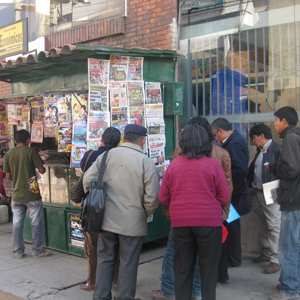
Many people start their day in Huancayo by picking up something to eat on the street, such as a tamal or bread with fresh cheese and a quinoa drink, and then stopping at the local newsstand to read the headlines.

Puesto de Periódicos en Huancayo
In Huancayo, reading the headlines at newspaper stands is a typical activity.
My vocabulary has expanded from reading Huancayo newspapers. Sports and politics are popular topics; unfortunately, the most common and notable words I’ve learned are: ahorcarse (to hang oneself), violar (to rape) and pepera (women who seduce and drug men at parties, clubs or bars to rob them). It’s true that death and domestic abuse are common here, but it makes me wonder about the media’s influence on what occupies Huancaíno thoughts and on the general mood in Huancayo. Have Huancaínos become desensitized, more afraid or grateful for the life they have?

The major headlines of my life right now are:

  • “Strep Throat Hits Twice.”
  • “Playing Catch-Up Daily But Finding Balance.”
  • “Huancayo Celebrations and Me.”
  • “Fulfillment from Growing Friendships with People all Over the World.”

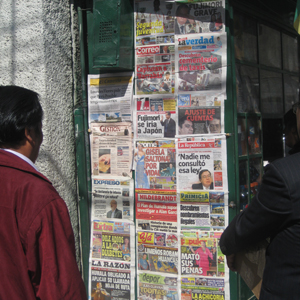
Noticias en Huancayo
These are the headlines in Huancayo. What are the headlines in your life?
These headlines are the thoughts that automatically come to me when I highlight what’s been happening in my life. It’s a form of self-talk that, as Janet Callaway describes, can powerfully program your subconscious mind to help or hinder you. Your self-talk reinforces your way of thinking whether you are empowering yourself with optimism and positivity, or putting yourself down.

What are the major headlines of your life right now? Are they empowering you or holding you back from positive change and growth?

Ahora sé que el tiempo es la única manera que tenemos para comprar nuestros sueños.” — Lucho Quequezana (link in Spanish) [I now know that time is the only means we have to buy our dreams.]

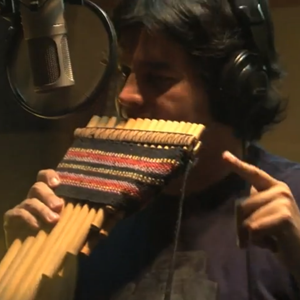
Lucho Quequezana Tocando La Zampoña
Lucho Quequezana's life changed when he was first introduced to the Peruvian panpipes in Huancayo.
Lucho Quequezana’s life changed when he moved from Lima to Huancayo at 11 years of age and found that his new schoolmates didn’t play soccer in their spare time; they played the Peruvian pan pipes instead. As he too learned to play the pan pipes, he slowly fell in love with his country and its music. Lucho would eventually travel all over Peru to immerse himself in regional music and master various Peruvian instruments from the charango (a small lute originating from the newly conquered Spanish Peru) to the quena (a traditional Andean flute).

Lucho’s parents forced him to bury his dream of becoming a musician, so he filled his life with his studies instead. In Lima, he studied Communications and ended up teaching at one of the best universities in the country, the Pontifical Catholic University of Peru. It was a comfortable life, but his love for creating traditional Peruvian music continued simmering in his heart, seeking a revival.

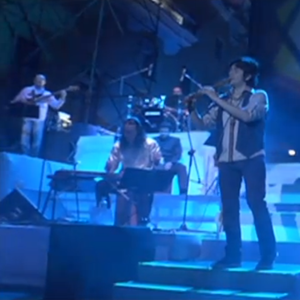
Lucho Quequezana y Sonidos Vivos en Concierto
Lucho Quequezana united musicians from different cultures to create Peruvian fusion music that they now share around the world.
It was a day like any other that Lucho decided to dedicate his life to his passion. The first step was winning the UNESCO Aschberg Bursary for Artists to organize a musical project in Montreal, Canada. Though he lacked the language, Lucho was still able to somehow express his big heart and his big dream to share and teach Peruvian music to musicians around the world, fusing cultures, sounds and rhythms. He eventually united artists from Turkey, Canada, Venezuela, Vietnam, China and Colombia to form the group, Sonidos Vivos (Living Sounds). Their first concert in Canada was a sold-out event and lauded as the best performance and best project of cultural fusion in the history of the UNESCO. Sonidos Vivos has since toured worldwide, acclaimed by music critics and winning not only awards, but also the hearts of people all over the planet, people who are now eager to play Peruvian instruments and hear more Peruvian tunes.

Lucho continues to tour with Sonidos Vivos and teach Peruvian music internationally. He has shared extracts of his compositions with Cirque du Soleil and has also produced a documentary of his group’s story and journey. Meet the multicultural members of the band and get a taste of Peruvian fusion music in this short promo clip of Sonidos Vivos’ world tour last year:

When and how have you valued time over money? How has music played a role in your life?

In 1995, Alberto Fujimori, the former president of Peru, promoted birth control by actualizing a national family planning program as part of his agenda to decrease population growth and therefore poverty. The program involved universal access to reproductive healthcare and sex education in schools. Proponents reasoned that the program would lead to decreased maternal mortality rates and empower women, especially rural women who would gain the ability to make choices about their reproductive health.

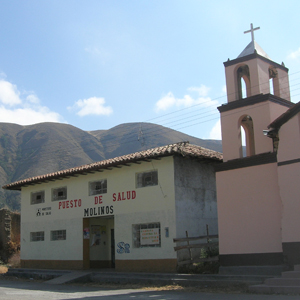
Puesto de Salud en Molinos
The health center in Molinos, a rural town almost two hours outside of Huancayo, is right beside the local church.
The entire plan placed Fujimori and the government in direct opposition to the Catholic Church, which plays a major role in Peruvian society. At the time, Cardinal Juan Luis Cipriani, one of the top 10 most powerful people in Peru, replaced the Ministry of Health’s sex education material with that of his own that was based on abstinence and sexual morality. To this day, the Catholic Church considers contraception immoral because the Pope says that it disrupts the natural reproductive process. Nevertheless, Fujimori powered through with the support of the media, the international community and the public.

We’re now seeing a similar phenomenon happen in the Philippines where there is currently intense debate over the Reproductive Health bills (“RH bill”) that has many of the exact same provisions as those of Fujimori’s program in 1995. This time, the Catholic Church is sure that promoting birth control, or what they refer to as “abortion-inducing drugs,” will increase rates of abortion, which is illegal there.

In countries where the Catholic Church plays an important role, should the Church also have a say in reproductive health and sex education? Should everyone in the world have equal access to birth control? Why or why not?

Peruvians will choose their new president in the second round of elections this Sunday. The competition is between Keiko Fujimori and Ollanta Humala who are neck to neck in the polls. Despite Ollanta’s wishy-washy proposals and his association with Hugo Chávez, he has gained a strong following with many of his supporters hardly voting for him than voting against Keiko.

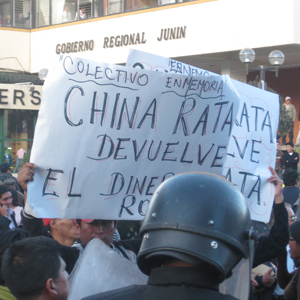
Oposición de Keiko
"Collective memory. Chinese Rat, give back the stolen money."
Keiko is the daughter of Alberto Fujimori, the former president of Peru from 1990 to 2000. Fujimori is recognized and appreciated for ending years of dreadful, violent terrorism in Peru and for stabilizing the country’s economy. At the same time, he was also found guilty of various corrupt acts and human rights violations. He is currently serving 25 years in prison.

Many people remember Alberto Fujimori for embezzling tons of money from the government and for killing off their families during the harsh stance he took against the terrorists, which often involved innocent people. Fujimori apologists argue that these undertakings were primarily headed by Vladimiro Montesinos, Fujimori’s chief advisor.

Universitarios Contra Keiko Fujimori
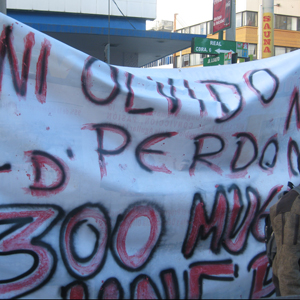
"I neither forget nor forgive. More than 300 dead. The National University of Central Peru."
Nevertheless, wherever you find Keiko these days, you’ll find people who are against her father. The diplomatic contend that she’s partly responsible for her father’s crimes because she was named Peru’s First Lady in 1994 at only 19 years old as her parents underwent a divorce. Others don’t have the courtesy to show reason and simply throw misattributed insults for Alberto Fujimori at his daughter, as his ad hoc representative. “Assassin!” they yell at Keiko, as if her father’s wrongdoings were her fault.

Below is a short clip of Keiko’s most recent visit to Huancayo last week during her presidential campaign. As she comes down the stairs amongst shouts of “Keiko for President!” you’ll hear a man shout: “China Rata!” calling her a rat as an insult.

Should Keiko be blamed for her father’s wrongs? Are you just like your parents? Can we ever really dissociate ourselves from our family? Will their errors always reflect on us and our errors on them?

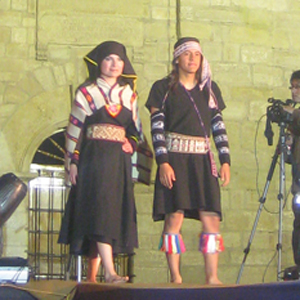
This week we’re celebrating Huancayo’s 439th birthday and the festivities started off with a fashion show in the main plaza, displaying and commemorating typical Huanca attire and regional costumes of the Andes.

Vestimenta Típica de los Huancas
This was the typical Huanca attire before the Spanish conquistadors arrived.
As part of Huanca clothing before the arrival of the Spanish conquistadors, sleeves (maquitos) were not only practical, but also a decorative addition to the daily outfit. Maquitos were attached to the shirt by a strip of material and easily removable, which made it convenient for the drastic weather changes in the Andes. A local university professor explained that in those times, women would knit elaborate maquitos for their partners to show their love.

How are gifts important to your relationships with loved ones, if they are at all? Do you make a point to give meaningful gifts? Why or why not?

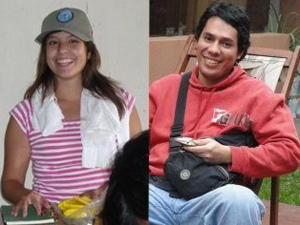
In early April, a young couple in their twenties disappeared in the Colca Canyon in Arequipa, Peru. On April 13th, they found Rosario Ponce López severely dehydrated. She had been eating insects and drinking her own urine to survive. They are still searching for her boyfriend, Ciro Castillo Rojo, to this day.

Ciro Castillo y Rosario Ponce
Ciro Castillo and Rosario Ponce were both lost in the Colca Canyon. Only Rosario has been found. © Facebook
The mystery of Ciro’s continued disappearance has grown in fervor with contradictions and secretiveness arising from Rosario’s stories.

  • She said that her cell phone lost its signal and ran out of battery during the days they were lost, but a mutual friend of the couple confirmed that he received phone calls and text messages from her mobile.
  • One of the cryptic text messages that she sent to the friend said: “Hurry, they haven’t found me yet.” She spoke only of herself and not of Ciro.
  • Rosario first told reporters that she and Ciro had walked off in different directions. Later, she changed her story, claiming that she was in a state of shock and didn’t know what she was saying. She now stands by the tale that Ciro went off to find help, but she couldn’t go with him because she felt really weak. When she woke up, he had disappeared.

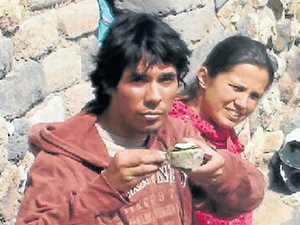
Ciro Castillo and Rosario Ponce
Ciro and Rosario were on a trip through the Colca Canyon before they got lost. © Facebook
People are suspecting homicide.

The President of the Committee of Attorney Generals in Arequipa says that Rosario has really important information for this case (link in Spanish), implying that she may not be sharing what she knows. Reinaldo Dos Santos, “The Prophet of America”, said in an interview a couple weeks ago that, “she’s trying to collaborate and she’s doing all that she can, but there are also things she’s not saying because of fear.”

When humans are deathly afraid of certain consequences, they react in different ways. In reflecting on my past, I handle similar situations by becoming painstakingly organized. I meticulously plan how I’ll manage all conceivable outcomes to the point of insomnia and losing my appetite.

How do you handle extreme fear? How have you seen people close to you handle extreme fear?

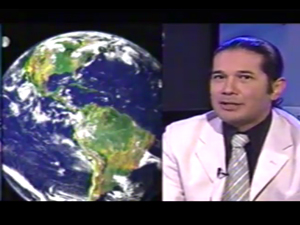
Reinaldo Dos Santos is known as “The Prophet of America.” Among his actualized predictions include the earthquakes in Haiti and Chile, the destruction of the Twin Towers and the election of Pope Benedict XVI.

Reinaldo Dos Santos
In last week's interview, Reinaldo made predictions about the world as he looked at a photograph of the earth.
Reinaldo has seen visions in his mind since his childhood, comparing them to schizophrenic voices. The mental images don’t always make sense to him initially and he has to do the research in order to interpret them, often studying other seers, such as Nostradamus, and the Mayan prophecies.

Last Sunday, he was interviewed by Reporte Semanal (Weekly Report), a Peruvian television program, in which he made his predictions for Peru and the world:

Predictions for Peru
  1. Keiko Fujimori would win the upcoming elections and become president. Keiko is the daughter of Alberto Fujimori, the ex-president of Peru who is recognized for conquering terrorism and stabilizing the country’s economy, but has also been charged for corruption and human rights violations.
  2. Peru will suffer a series of major natural disasters within the next eight years and the new president who will be elected on June 5th should make emergency preparedness a priority. Furthermore, Lima will be hit by an earthquake and it won’t be just any earthquake, but “THE earthquake.”
Predictions for the World
  1. Barack Obama will be reelected. Even though he has disappointed many Americans who believed in him, they still have hope.
  2. Canada is one of the most prepared countries for the critical consequences of global warming.
  3. Hugo Chavez won’t be reelected, but he may remain in power.

Reinaldo admits that he, as a flawed human being, can interpret his visions incorrectly and he believes that God ultimately has the power to make changes, but so far every major event he has predicted has come true.

Do you believe in modern-day prophets or are they scams? Do you believe that we can be our own prophets with enough research and an intuitive, big-picture understanding of the world? If you could really know your future, would you want to know? Why or why not?

Copyright © 2026 Samantha Bangayan | Sitemap | Disclosure Policy | Comment & Privacy Policy
All articles and photos in this blog are licensed under the Creative Commons Attribution License CC BY-NC-ND 3.0.