
Now that I live in Peru, I’ve often been asked, “Where is home now?”
It seems like a simple question. Of course, it’s wherever I currently live. But Peru’s not my only home.
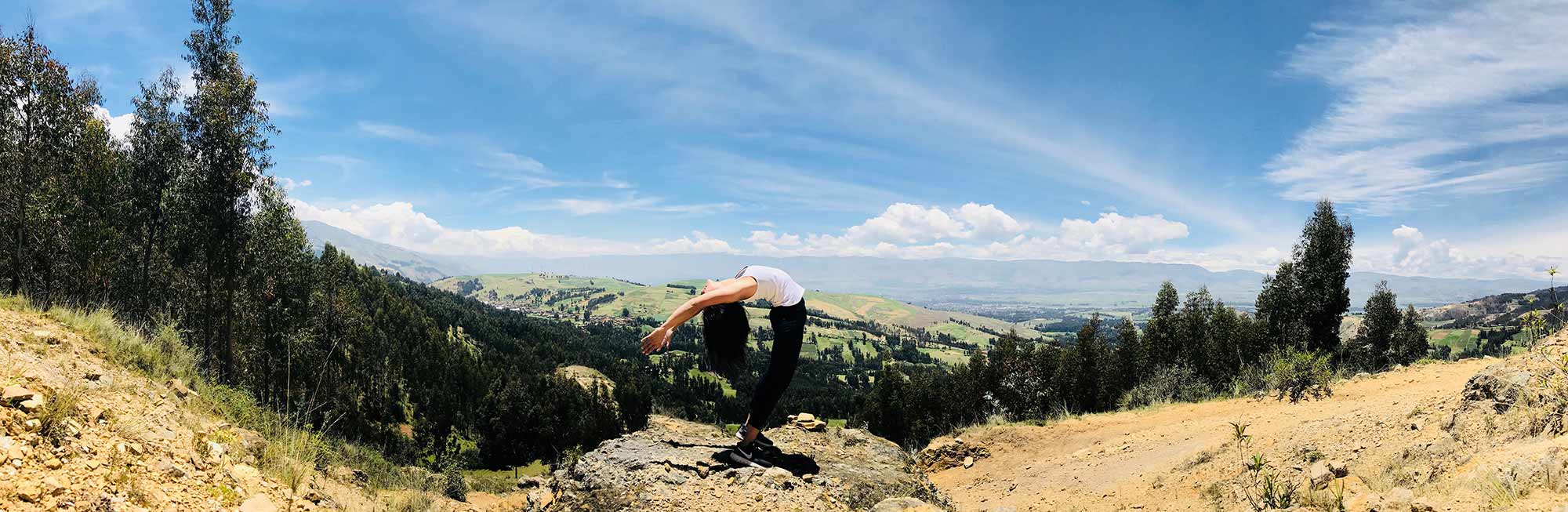
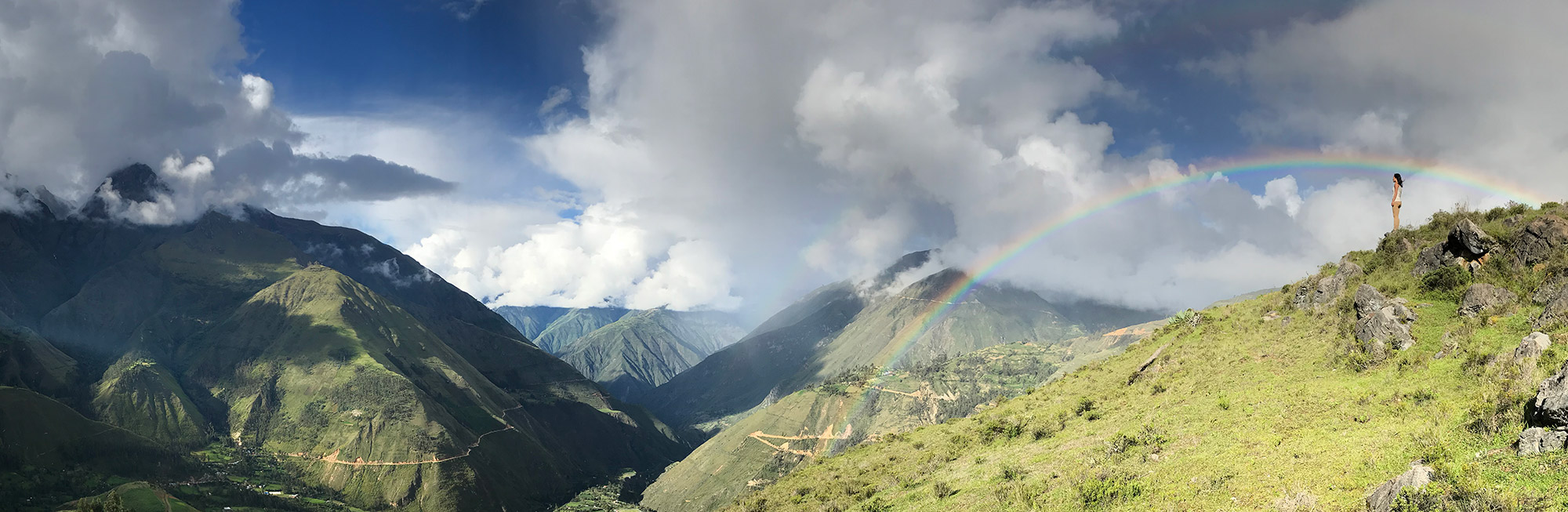
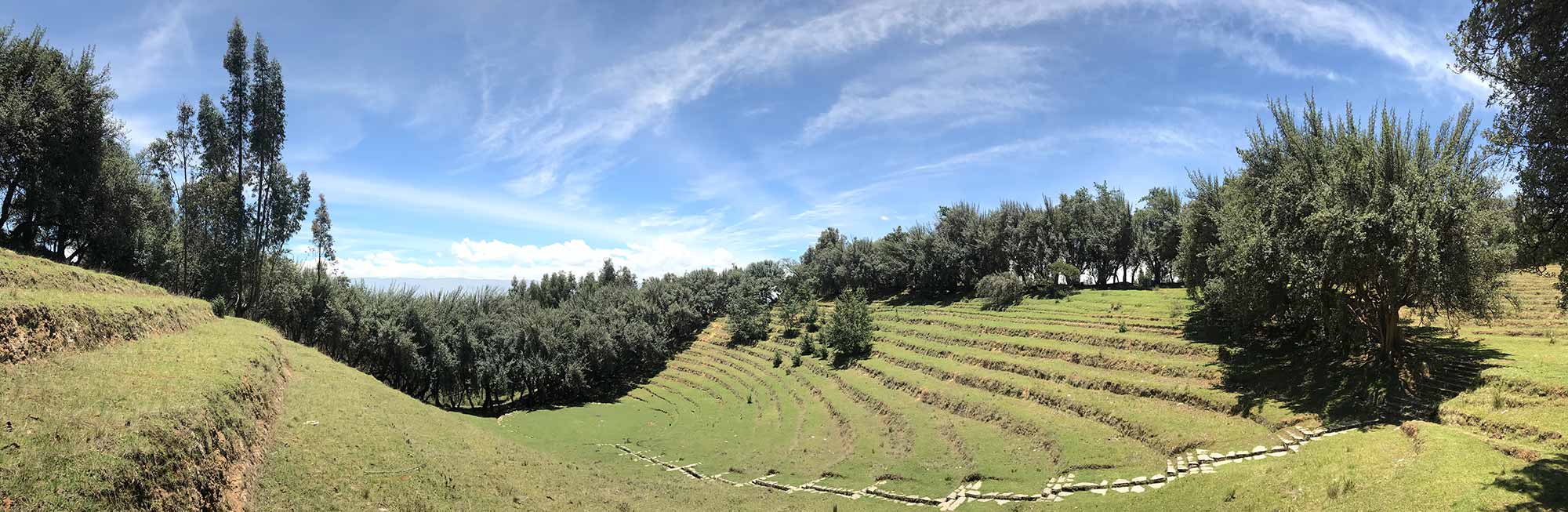
Now that I live in Peru, I’ve often been asked, “Where is home now?”
It seems like a simple question. Of course, it’s wherever I currently live. But Peru’s not my only home.

The Chinese have been living in Peru since they arrived on ships that traveled across the Pacific in the 1850s. They were the first Asians to make it to South America and came as coolies who worked in guano mines and sugar plantations.
San Pedro de Saño is a relatively rural town around half an hour outside of Huancayo. One of its poorest neighborhoods is filled with immigrants from Huancavelica, the poorest province in Peru. There, everyone knows each other, many are intricately related to each other, and children play freely in the streets.

I had the opportunity to visit a farm deep in the Andes around an hour’s walk away from the closest town and almost five hours away from Huancayo by car. I’ve found that rural areas always have a certain beauty about them and the view from where their farm sits almost seems like the majestical land around Machu Picchu.

“When adults say, ‘Teenagers think they are invincible’ with that sly, stupid smile on their faces, they don’t know how right they are. We need never be hopeless, because we can never be irreparably broken. We think that we are invincible because we are.” — John Green, “Looking for Alaska”
Skateboarding in Peru is as much a part of the youth culture as hip hop and breakdancing. I recently attended a local skateboarding event and competition at the skatepark here in Huancayo:
Every October, the country turns purple for mes morado (purple month) in honor of the Señor de los Milagros (the Lord of Miracles). Its history dates back to the 1600s to an Angolan slave in Lima.
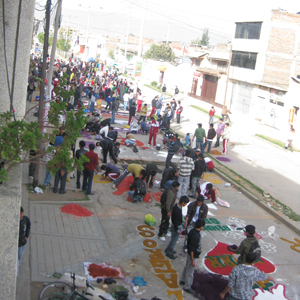
This very wall would survive over three centuries to the present day. Soon after the first miraculous occurrence, the viceroy ordered the wall destroyed after noticing all the people worshipping it with what seemed like pagan rituals, but strange things would happen to every person that approached the wall with the intention of destroying it or erasing the painting. A painter started trembling and felt goosebumps in fear when he approached the painting. A soldier witnessed the image of Christ become more beautiful and Christ’s crown turn green. People began protesting as they heard about these new miracles and the order was eventually revoked.
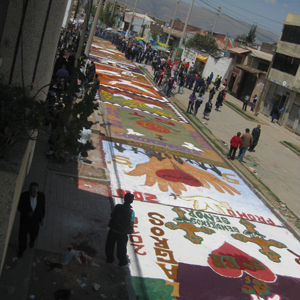
The procession has been an annual event since then. It happens all over Peru and around the world, including Australia, Egypt, Italy, and the United States to name a few countries. Here in Huancayo, companies and schools wake up early in the morning to prepare “carpets” of woodchips along the procession path as the Señor de los Milagros makes a roundtrip pilgrimage to and from the central Catholic church at the main plaza. It’s also tradition to eat turrón (a nougat-type dessert) during purple month — as the story goes, Doña Pepa, an African slave, dreamed of the recipe the night that the Señor de los Milagros cured her of paralysis.
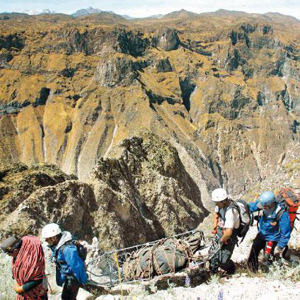
These days, the Peruvian news is all about Ciro Castillo Rojo. After more than 200 days of being lost in the Colca Canyon in Arequipa, Peru, they have found his lifeless body intact at the bottom of a cliff, 1400 meters below a viewing point in the tourist area. They recognized him by his clothes, pink watch, and gold necklace as seen in the last photos we had of him. It took 65 people 30 hours to get his body out of there and to a nearby town.
Only time and an autopsy will reveal the cause of death and bring another onslaught of emotions.
I can’t even imagine what it must have been like for Hiram Bingham when he came upon the forgotten Inca site of Machu Picchu in the Peruvian Andes in 1911 and presented it to the world. There must be better words to describe feelings like excitement and glee, but tenfold!
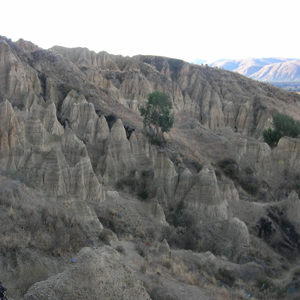
There have been various attempts to locate Paititi over the last century with one of the most recent ventures in 2008 led by the American explorer Gregory Deyermenjian who has conducted more than 10 past expeditions in search of the lost city. That same year, Peruvians discovered what they thought to be a stone fortress that could be Paititi near Cuzco, which they later dubbed Manco Pata. Unfortunately, upon closer examination, they found the ruins to be naturally formed rather than human made.
The first time I truly felt and listened to the explorer in me was during my early years in university. I had a particularly adventure-minded friend and together we raced through the forest of the local golf course in the middle of the night, getting pricked by pine needles and soaked in swamps, and inspected parts of the university beach that seemed abandoned. I left that side of me behind as I began to focus on my studies and didn’t rediscover it again until I arrived here in the Andes and trekked through its mountains.
How has the explorer in you shined through in the past or how does it currently shine through?
There is a markedly different feeling here in Peru that I seldom feel in Canada: pride in one’s country. I often hear: “¡Que viva el Perú! ¡Que viva!” or “¡Arriba Perú!” which loosely translates to “Long Live Peru!” or “Go Peru!” depending on the context. You’ll hear it every time you sing the national anthem, at every sports game, and often in the news to create solidarity.
Sometimes, we also find the same pride for all of Latin America. That’s what shone through in Calle 13’s new single, Latinoamérica, which currently holds the Latin Grammy nomination for Song of the Year. With an introduction in Quechua from a radio station in Cuzco, Peru, these Puerto Rican brothers celebrate what it means to be Latin American, featuring female singers from Peru, Colombia, and Brazil. What’s so beautiful about this work of art is how it presents the true range of faces, experiences, and images you’ll find in Latin America. Peruvians are particularly proud of this short film because many of the shots are from their country, the graffiti artists are Peruvian, and a famous Afro-Peruvian singer, Susana Baca, sings part of the chorus. Calle 13’s Latinoamérica is our Latin America:
Here’s a translation of some of the poetic lyrics of Calle 13’s Latinoamérica:
The ladies sing in the chorus, “You can’t buy the wind…the sun…the rain…the heat…the clouds…the colors…my happiness…my pain,” speaking to the fact that what is truly valuable isn’t bought with money. And through their lyrics, Calle 13 seeks to demonstrate that what we can be proud of has nothing to do with politics or the economy. It’s about the land and about who we are as humans.
In Huancayo, there’s mutual disrespect when it comes to pedestrians: Cars rarely give pedestrians the right of way and pedestrians rarely pay attention to designated crosswalks and crossing times. I’ve learned to be both a defensive pedestrian, stopping and judging risk so that I’m not a victim of crash accidents, and an offensive pedestrian, confidently stepping out onto the street in the face of traffic.
I have often been forced to race across highways, dodging reckless drivers. That’s what Percy Rosales Sosa did when he was hit. He died yesterday at 18 years of age.
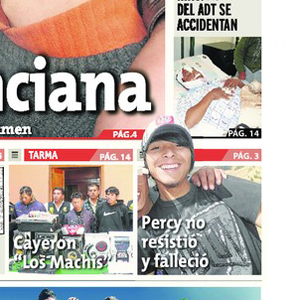
By the time Junior got to Percy, he was having a seizure on the highway. The taxi driver helped Junior lay Percy in the car and they took him to the nearest hospital. During the ride, Percy came to and complained about having a headache. What they would later learn were skull fractures would prevent Percy from raising his head. Despite the gravity of the situation, Percy’s father maintains that the doctors at the local hospital purposely delayed in attending to him (link in Spanish) because he didn’t have health insurance. Almost a day later, possibly due to the lack of medical attention, Percy had a stroke and fell into a coma until he passed away.
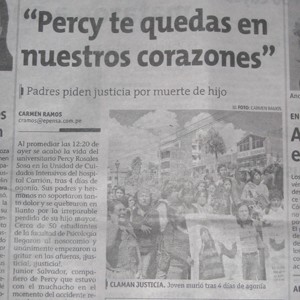
I’ve always noticed that death was more open here in the Andes, but I never thought that one of the people on the front page of the paper would be someone I knew.
Does knowing and remembering that life is short make you more or less of a risk taker? In what ways?